
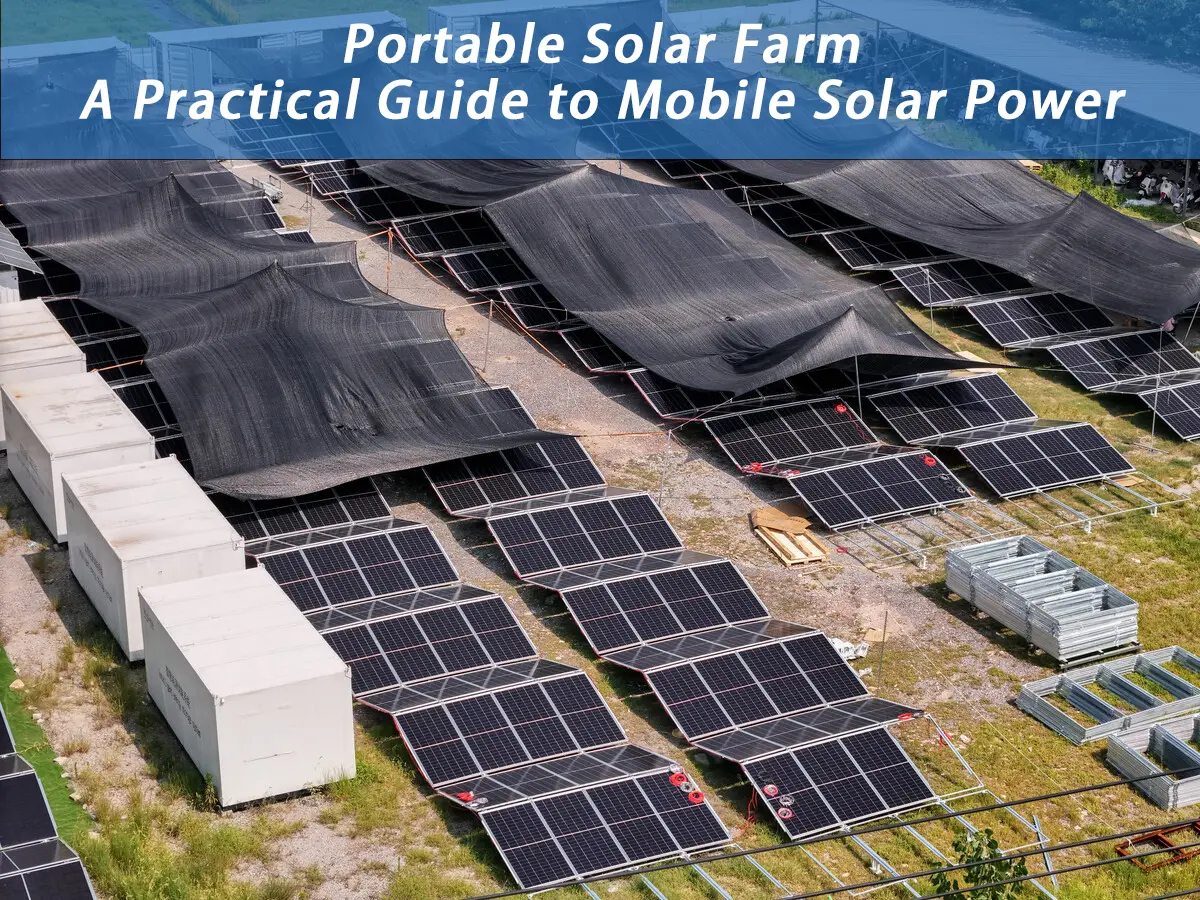
A portable solar farm has evolved into a practical energy solution that serves construction sites, humanitarian missions, remote communities, disaster-response teams, and small businesses looking for clean, mobile power.
What is a Portable Solar Farm?
A portable solar farm is a modular photovoltaic power system that may be easily transported, deployed, and moved to other sites as required. While the more traditionally used solar farms are installed permanently with heavy infrastructure, portable systems are designed for mobility and to be set up quickly.
A typical portable solar farm would contain:
- Foldable or retractable solar panels
- Energy storage batteries (usually LiFePO4 for safety and long life)
- Inverter, charge controllers, monitoring equipment
- A structural frame or case for transportation
Scalability also means that several portable units can be combined, forming a solar array that will power equipment, buildings, and microgrids.
That's where mobile folding PV containers come into play. Deploying multiple containers side by side enables users to build a fully functional portable solar farm without complex engineering.
How Portable Solar Farms Work
Although designs vary, the working principle is straightforward:
- Capture: These panels absorb sunlight and transform it into DC electricity.
- Convert: Inverters convert DC into usable AC electricity.
- Store: Batteries store excess energy for nighttime or cloudy conditions.
- Supply: The system serves loads directly or feeds a local microgrid.
Because all of these components are integrated into a transport-ready structure, the whole system can be established in a matter of minutes to hours, depending on scale.
Why Portable Solar Farms Are Growing So Fast
Several market forces are accelerating demand:
1. Increasing Demand for Mobile Power
Construction, mining, and telecom sites are increasingly requiring electricity in remote locations. Diesel generators are expensive and noisy. Portable solar systems provide a cleaner alternative.
2. Disaster Response and Humanitarian Relief
They provide immediate electricity after hurricanes, earthquakes, and wildfires without being dependent on damaged fuel supply chains.
3. Electrification in Developing Regions
Rural communities often do not have permanent grid access. Portable solar farms provide a flexible option for temporary or semi-permanent microgrids.
4. Growth in Off-Grid Living and Outdoor Industry
Mobile solar is soon becoming a preferred power source, from recreational events to research expeditions.
Real-World Example: Building a Portable Solar Farm with Moblile PV Containers
The portable solar farms can be established through connecting various mobile solar containers together, for instance:
- Each container includes foldable solar panels that deploy to form a larger array.
- Because of this, energy storage is built in, with no external battery banks required or needed.
- Transportable by truck or ship, it can also be put into operation independently.
This can scale the user from a small off-grid setup to a multikilowatt or even megawatt-level solar farm with three to ten units. What makes the technology so versatile is the modularity.
Here is a simplified example of configuration:
| Number of Units | Solar Capacity | Energy Storage | Deployment Time |
|---|---|---|---|
| 1 Unit | 10–20 kW | 20–40 kWh | < 1 hour |
| 5 Units | 60–100 kW | 100–200 kWh | 2–4 hours |
| 10 Units | 120–200 kW | 300–500 kWh | 4–8 hours |
These values vary between manufacturers, but they illustrate how easily portable solar farms scale by using modular equipment.
Key Benefits of a Portable Solar Farm
A portable solar farm has a few key advantages over diesel generators and fixed solar installations:
1. Fast Deployment
Most container-based systems require only minimal installation. The fold-out panels dispense with the need for mounting structures.
2. Clean and silent
No emissions, no fuel logistics, no noise from generators.
3. Scalable and Flexible
Add or remove units depending upon power needs.
4. Reliable Power Storage
Modern systems use LiFePO4 batteries because of their long cycle life and safety.
5. Lower Long-Term Cost
Even though the initial cost is greater than for diesel generators, operating costs are much lower. The savings on fuel justifies the investment in many cases.
Future Trends: Where Portable Solar Farms Are Headed
Various trends come to the fore based on current happenings within the sector:
- Higher-energy-density panels: Allowing more output from the same footprint.
- Liquid cooling integrated BESS: enhancing the life of batteries during hot climates.
- Energy management through AI: Automatic load distribution adjustment and power generation.
- Hybrid configurations: Solar combined with wind, hydrogen, or high-capacity mobile batteries.
- Smarter logistics systems: Standardized container designs simplify transport and stacking.
Being a regular evaluator of renewable-energy products, I have found that today's buyer is looking for much more than just power output; they seek versatility. They want a system that can handle remote work this month and an emergency relief mission next month. Portable solar farms fit that requirement perfectly.
When Does a Portable Solar Farm Make Sense?
A portable solar farm is particularly helpful when:
- The project site may change over time
- Fuel supplies are expensive or unreliable.
- Silence and clean energy count.
- Quick deployment is vital.
There is no grid access in the area. Portable solar systems are often a better option if a user expects long-term mobility or prefers to avoid the hassle of diesel generators.
Final Thoughts
A portable solar farm is an efficient and scalable, yet environmentally-friendly energy solution for most off-grid situations. With the uprise of mobile folding PV containers, complex installations are not required even to deploy multi-kilowatt systems. As technology continues to evolve, portable solar farms are becoming not only more capable but also more cost-effective, positioning themselves as a good competitor to traditional temporary power sources.