
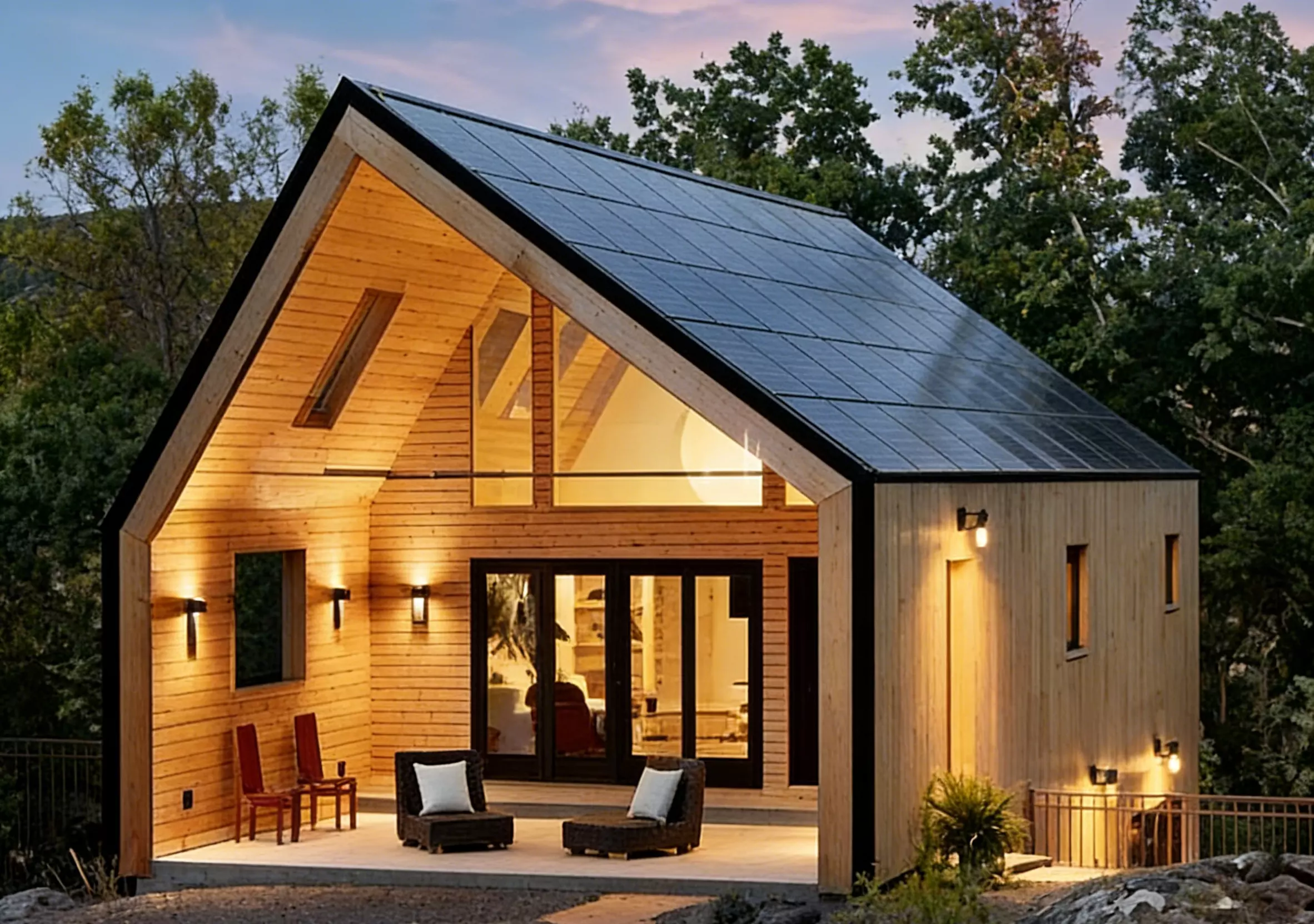
Why are more and more wooden houses starting to choose off-grid solar systems?
Whether it is cabins deep in the forest, mountain holiday homes, or remote real estate without power grid access, more and more people want to make their wooden houses truly "energy self-sufficient".
The reason is very simple:
Wooden houses are often built in remote areas, and the cost of pulling the power grid is high, the cycle is long, and it is even impossible to access.
Electricity prices continue to rise, making the dependence on the power grid more and more unprofitable.
Power outages caused by storms, blizzards or extreme weather make people aware of the importance of backup power.
Solar energy + energy storage is mature, safe and stable, which is enough to support the year-round electricity consumption of wooden houses.
For many wooden house users, having their own solar power for off-grid cabin not only means that they can use electricity at any time, but also represents a free, safe and sustainable lifestyle.
And the purpose of this article is very clear:
Use the clearest steps to teach you how to build a reliable off-grid solar setup for cabins for wooden houses. From demand assessment to installation and maintenance, there is no difficulty.
What is an off-grid solar system?
Off-grid Solar System, as the name implies, is an independent power supply system that does not rely on the public grid.
For ease of understanding, it can be regarded as a "micro power station":
Solar panel → Charging controller (MPPT) → Battery energy storage → Inverter → Household appliances
What is the difference between online and off-network?
| Type | Characteristics |
| Grid-tied | Connected to the utility grid; solar powers loads by day, grid supplies power at night. |
| Off-grid | Fully self-sufficient; all energy comes from solar and batteries, with no grid reliance. |
Wooden houses, campsites, remote farms and forest cabins usually choose off-grid systems, because:
Can't connect to the power grid
I don't want to bear the expensive power grid construction cost.
Pursue independence and sustainable life
Step 1: Evaluate the daily electricity needs of wooden houses
The first step in designing any cabin solar energy off-grid system must start with "how much electricity you use every day".
Without this step, there is no way to choose panels, inverters and batteries in the future.
3.1 List the power and usage time of all devices
Here is a reference form for everyone:
| Device | Rated Power (W) | Daily Usage (h) | Energy per Day (Wh) |
| LED light | 10 W | 5 h | 50 Wh |
| Refrigerator | 100 W | 10 h | 1,000 Wh |
| Laptop | 60 W | 3 h | 180 Wh |
| Water pump | 300 W | 1 h | 300 Wh |
| Phone charging | 10 W | 2 h | 20 Wh |
The total daily power consumption is about:
1,550Wh/day (≈1.55kWh/day)
3.2 Calculate Peak Load
You need to know "how many devices can be opened at the same time".
For example:
Refrigerator (100W)
Lamp (30W)
Water pump (300W)
Peak power = 100+30+300 = 430W
Plus 20% safety factor ≈ 520W
Therefore, the inverter needs at least 700W-1000W to be stable.
Step 2: Choose the capacity of solar panels (the roof area of the wooden house is also crucial)
The core considerations of solar panels include:
Panel power (W)
Series and parallel connection method
The direction and inclination of the roof
Less sunshine in winter
Your location latitude (the north and the south are very different)
How to estimate the total power of the required panel?
The formula is very simple:
Total panel wattage = daily power consumption ÷ local average sunshine hours
Assuming that the location of the wooden house is an average of 3 hours of sunshine per day:
1.55kWh ÷ 3 = about 520W
In addition to the unstable weather, cloudy weather, winter decline and other factors, it is generally recommended that:
Choose 1.5–2 times the panel capacity → 800W–1000W is more reasonable
If it is a small cabin, you can choose:
Solar off-grid system for small cabin 600–1000W level
If it is a remote cabin, you need a larger reserve, you can choose:
Solar power kit for remote cabins 1.2–2kW level
Step 3: Selection of energy storage batteries
Solar panels are responsible for "power generation",
And the battery is the core of the whole off-grid cabin.
5.1 Comparison of common battery types
| Type | Cost | Life | Usable Capacity | Suitable for Cabin? |
| Flooded Lead-acid | Low | Short | 50 % usable | Not recommended |
| AGM | Medium | Medium | 60 % usable | Usable, but not ideal |
| LiFePO₄ (Lithium Iron Phosphate) | High | Long | 80–90 % usable | Highly recommended |
LiFePO4 battery is almost a must for wooden houses, because:
Low temperature resistance (some models have heating function)
Long service life (3000–6000 cycles)
Strong deep discharge ability
Safe and stable (BMS protection)
5.2 Calculate the battery capacity
Required battery = daily power consumption × standby days ÷ discharge depth (DoD)
Suppose you want to have a 2-day reserve:
1.55kWh × 2 ÷ 0.8 ≈ 3.8kWh
Therefore, you should choose:
4–5kWh LiFePO4 battery combination
If it is a remote cabin, it is recommended to raise it to 6–10kWh (long-term residence is more stable).
Step 4: How to choose an inverter?
The inverter is responsible for converting the direct current of the battery into AC household electricity.
Key parameters:
Continuous output power
Peak Impact Power
Waveform: pure sine wave vs correction wave
Whether to have MPPT
Why does it have to be pure sine waves?
Because the commonly used equipment of wooden houses (refrigerators, water pumps, computers) has high voltage requirements,
Correction waves will cause:
The device heats up
Noise
Risk of damage
Inverter power suggestion:
Small cabin → 1000–2000W
Medium-sized cabin → 3000W
Long-term residence cabin → 5000–8000W
Step 5: Accessories that have to be bought by the wooden house off-network system
A complete DIY off-grid cabin solar package must include these:
Circuit breaker / fuse
Isolation switch
Lightning renter SPD
DC / AC distribution box
Grounding rod
Install the bracket
Waterproof wiring
Wooden houses are often located in humid areas, and these accessories are more important than urban residences.
Step 6: Standard installation process of off-grid solar system
Here is a standardized "wooden house installation order" for you:
Choose the installation location on the roof/ground
Fixed solar bracket → Install the panel
Connect the panel to the MPPT controller
Connect the battery pack (ensure the correct polarity)
Install the inverter and connect it to the battery
Set up protection devices (circuit breakers, lightning protection)
Too the AC load
Test system
Set up the monitoring application
Daily use and maintenance of wooden houses
Clear the snow in winter
Check dust and fallen leaves regularly
Keep the battery dry
Don't let the battery fall below 20% for a long time.
Check MPPT data regularly
The use of generators can be reduced in summer.
It is recommended to reserve more energy storage in winter.
FAQ
1. What to do on rainy days or winter?
You can rely on large-capacity energy storage + backup generator.
2. Can I buy a set of small system for subsequent expansion first?
Yes, as long as MPPT and inverter parameters are supported.
3. Is the off-grid solar system of the wooden house safe?
As long as you install + use the protective device according to the specifications, it is very safe.
4. Do I have to find a professional?
DIY is feasible, but the key parts (battery wiring, lightning protection) are recommended by professionals.
Create real energy independence for your wooden house
Do you want wooden houses to have stable electricity in the mountains, lakes and forests?
A set of reasonably designed solar power kit for remote cabins can be realized.
With the maturity of solar energy technology and the reduction of energy storage costs, "completely off-grid life" is no longer a dream.
Whether you are a weekend holiday home, a remote cabin, or you are going to live for a long time,
The off-grid solar system is the most stable, economical and free energy mode.