
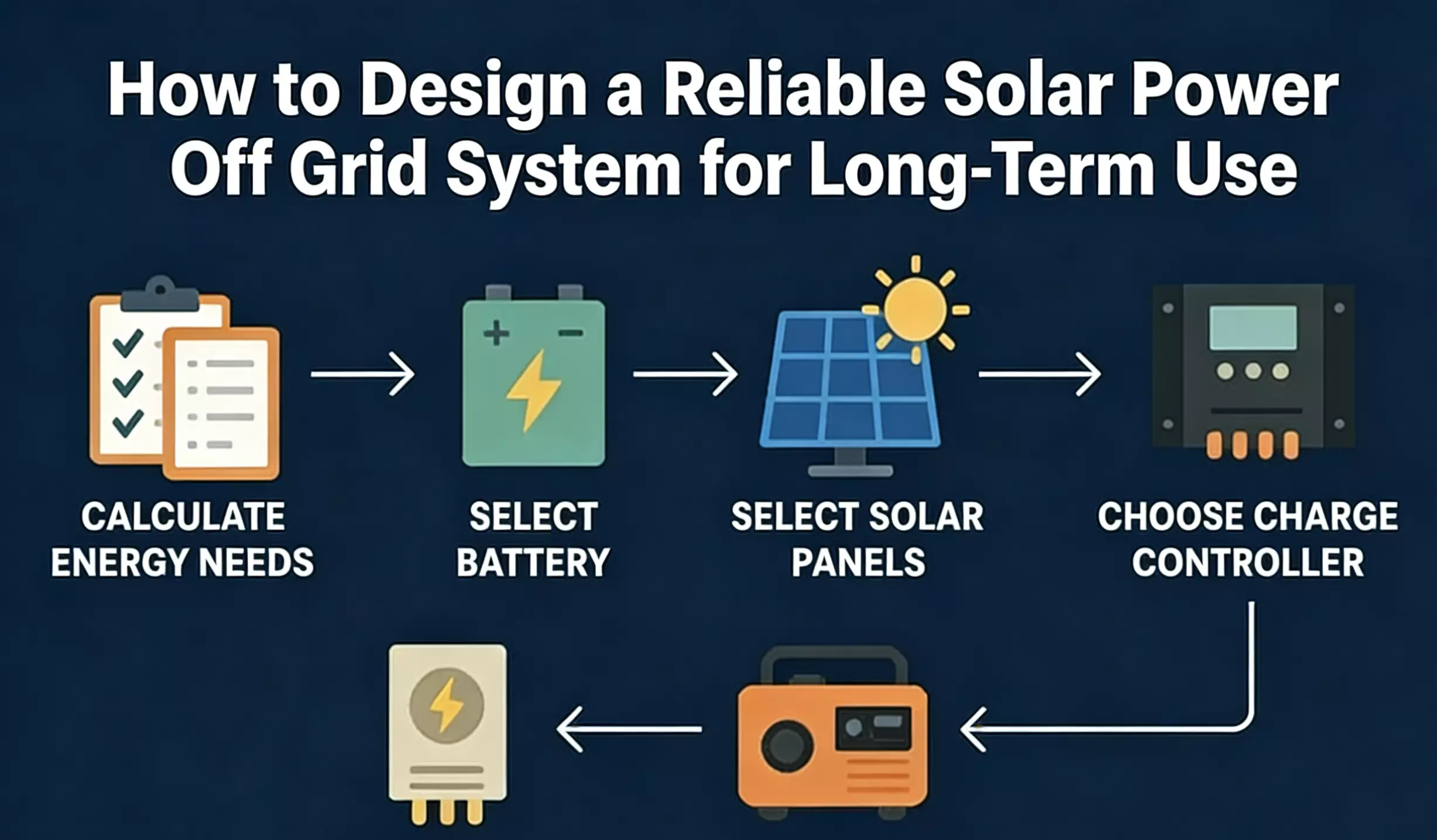
Why must the off-grid solar system be “reliable”?
Today, when energy prices are rising and extreme weather is frequent, more and more families are beginning to pursue energy independence, and Off-Grid Solar System has gradually become a "necessity" for many homeowners, RV travelers and cabin owners.
But everyone who has really used the off-network system knows:
Unreliable off-grid system = life may have a power outage at any time.
1. Off-network vs-network: What's the difference?
| Item | Grid-tied System | Off-grid System |
| Power Source | Mainly from the public grid | Completely independent from the public grid |
| Supply during outage | Mostly no | Yes, as long as battery energy is sufficient |
| Battery required | No | Yes (core component) |
| System stability | Supported by the grid | Entirely dependent on self-design |
There is no "spare tire" in the off-grid system. If any link is not reliable, it will lead to the paralysis of the whole system.
2. Why is long-term stability so important?
Continuous rain in winter → Battery with insufficient capacity will cause power outage at night
Insufficient load of the inverter → Unable to drive key household appliances such as refrigerators and induction cookers
Unstandardized wiring → more prone to thermal loss, short circuit or system decay
Low configuration of solar panels → Satisfactory charging, the more you use it, the more power loss
Therefore, a long-term and reliable off-grid system must be "clearly calculated, installed and used stably" from the beginning of the design.
3. Applicable scenarios: These users especially need off-network systems
Cabin in a remote area (Cabin)
RV / VanLife Full-time Stay
Farm independent power supply demand
Post-disaster backup power (such as hurricanes and blizzard high incidence areas)
Temporary electricity for outdoor camp/construction site
If you pursue a cheap (cheap / affordable) off-network solution, you should do your homework in the early planning and avoid later rework.
Full analysis of off-network system composition
A basic off-grid solar system is mainly composed of five core components:
1. Photovoltaic panels
Convert solar energy into direct current (DC)
The key to the power generation of the system
Common types:
Monocrystalline silicon (the highest efficiency) > Polycrystalline silicon > Flexible solar panels (portable)
2. MPPT Solar Controller
Its function is to optimize the efficiency of solar energy conversion and charge the battery safely.
Compared with PWM, MPPT can improve efficiency by 20-30%.
3. Inverter
Convert direct current (DC) into alternating current (AC) available for home appliances.
Pure sine wave inverters are a must for off-grid:
It can drive refrigerators, air conditioners, computers and other sensitive equipment.
The waveform is more stable and does not damage the equipment.
4. Battery Storage System
The "core" of the off-network system.
All electricity after the sun goes down is supported by batteries.
Battery type:
LiFePO4 (first choice): safety, long life, number of cycles 4000+
Lithium-ion battery: cheaper, but shorter life
Lead-acid battery: low cost but not recommended for long-term off-grid use
5. Wires, cables, circuit breakers, fuses
These are "invisible parts", but they are extremely critical to system security.
Wrong wiring = fire risk.
Step 1: Calculate your electricity demand (the most critical step)
If this step is wrong, all the designs will "deviate from the track" later.
1. Average daily electricity consumption (Wh)
Formula:
Electrical power (W) × daily usage time (h) = daily power consumption
For example:
Refrigerator 120W × 24h ≈ 2880Wh
Router 15W × 24h = 360Wh
Lighting 50W × 5h = 250Wh
The total power consumption is about: 3490Wh/day
2. Peak load (determining the power of the inverter)
Add up the power of all the devices that may be turned on at the same time.
For example:
Refrigerator (120W) + Computer (150W) + Kettle (1200W)
A maximum of ≈ 1500W–1800W inverters may be required.
3. Spare days (continuous rainy days)
Off-network systems are usually designed according to 2 to 3 days of backup.
3490Wh × 3 ≈ 10.4kWh battery capacity (actual recommendation ≥ 12kWh)
Step 2: Design the capacity of solar panels
1. How much electricity can solar panels send every day?
Formula:
Panel power × daily effective daylight hours (HSP) × 0.75 (actual efficiency)
For example, 400W solar panels, in 4-hour effective sunshine areas:
400 × 4 × 0.75 ≈ 1200Wh / day
2. HSP (Effective Daylight) in different regions
California, USA: 5–6 hours
Central Europe: 3–4 hours
United Kingdom: 2–3 hours
3. There is a huge difference between winter and summer.
The power generation in winter may be only half of that in summer.
Therefore, the system capacity cannot be calculated only by "summer".
4. Shielding and tilt optimization
Is there a tree behind? The efficiency is directly reduced by 20–40%
The southward inclination angle is higher (Northern Hemisphere)
Try to avoid the shadow of the eaves
Step 3: Choose a suitable energy storage battery (core off-graid)
Why is LiFePO4 the first choice off-network?
Number of cycles 3500–6000 times
High security, not easy to lose control of heat
Support high-current charging and discharging
The lifespan is much higher than that of lithium ion and lead acid.
How to calculate the battery capacity?
Average daily electricity consumption × standby days × energy storage loss coefficient (1.1)
For example:
3490Wh × 3 × 1.1 ≈ 11.5kWh
At least 12–15 kWh is recommended.
48V vs 24V vs 12V system
| System Voltage | Characteristics | Recommended Applications |
| 48 V | High efficiency, low line loss, supports high power | Households & large off-grid systems |
| 24 V | Balanced solution | Cabins, RVs, medium systems |
| 12 V | High current, high loss | Low-power portable devices |
Why is BMS (Battery Management System) important?
Avoid overcharging/overcharging
Improve safety
Increase the cycle life
For example, Huijue's wall-mounted energy storage battery/portable power supply uses LiFePO4, which is more suitable for long-term off-network use.
Step 4: Choose an inverter suitable for long-term off-grid
Inverters are the "most prone to problems" equipment in the system.
1. Pure sine wave must be selected
Otherwise, refrigerators, computers, air conditioners, etc. will be damaged.
2. How much power is more stable?
Cabin: 1500W–3000W
Family: 3000W–5000W
Farm: up to 8000W+
3. The best is the hybrid mode (Solar + Battery + Generator)
When it is cloudy continuously, the generator's auxiliary charging is life-saving.
4. UPS switching speed (≤10ms ideal)
5. Inverter efficiency
The efficiency gap between 90% and 96% is huge--
Long-term use means more power waste or more power saving.
Design skills to improve system stability
The line loss calculation must be accurate (the thicker the line, the better)
Avoid overload operation
The cable should be as short as possible.
Keep the position of the controller and inverter ventilated
Outdoor equipment must be ≥ IP65
Inverters are most afraid of high temperature - heat dissipation space must be maintained in summer
Long-term maintenance and safe use guide
Regularly check whether the wiring is loose.
Clean solar panels (dust will reduce efficiency by 10–20%)
Avoid deep discharge of the battery
Pay attention to the temperature of the inverter
Check the fuse/circuit breaker
Some unnecessary circuits can be turned off if you go out for a long time.
Complete case: three budget-level off-network schemes
1. Cottage Plan (2–5 kWh) - Budget Entry
Suitable for weekend vacation cottage/camp
1200–2400W solar panel
2–5kWh LiFePO4 Battery
1500W inverter
Budget: low cost, easy to install
2. RV plan (1.5–3 kWh) - Affordable & Portable
Suitable for full-time VanLife
600–1200W solar panels
1.5–3kWh battery
1500–2000W inverter
It can be used with portable solar power supply, such as 600W/1200W/2500W Portable Power Supply.
3. Family or Farm Plan (5–10 kWh+) - Long-Term Reliable
Suitable for long-term off-line life
3000W solar panel
10–20kWh battery
3000W–6000W hybrid inverter
You can integrate your home energy storage products to achieve higher stability.
How to choose the most suitable off-network system for you?
The final choice depends on:
✔ Your daily electricity consumption
✔ Budget (cheap / affordable / economical)
✔ Do you need to leave the network for a long time?
✔ Do you need to expand the ability?
If you are not sure where to start, you can:
Refer to the calculation formula in this article, according to your usage scenario, or contact us directly, we can provide a complete plan according to your needs!