
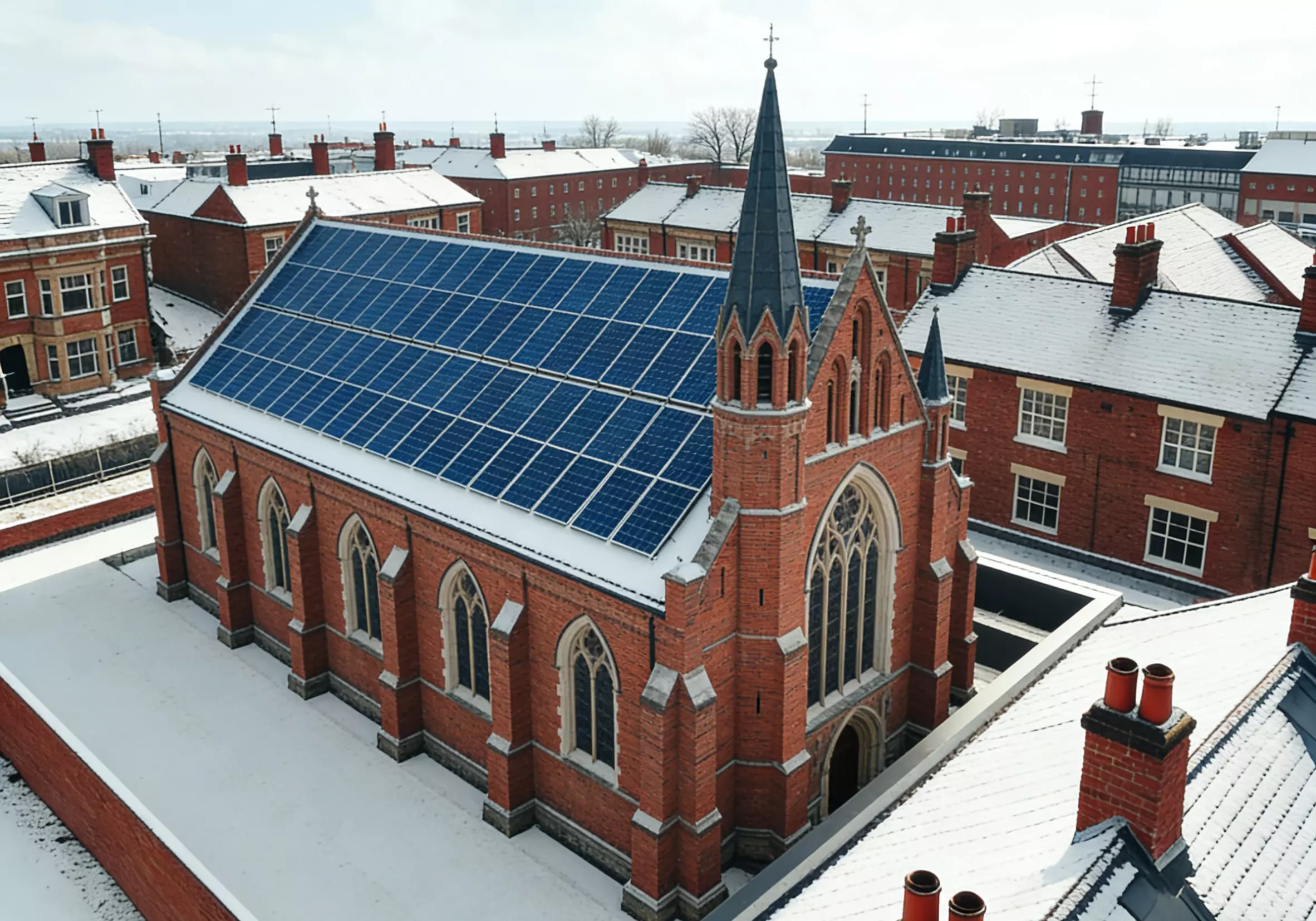
In Britain, when it comes to solar energy, many people's first reaction is:
"It's too cloudy and cold in winter. Solar energy is useless at all, right?"
But the opposite is true.
Modern photovoltaic systems can still generate electricity in winter, especially off-grid solar power systems in winter UK. With reasonable design and correct configuration, they can still provide stable electricity for families, cottages, farms or RVs in the cold season. Force.
Starting from the real lighting environment in winter in the UK, this article will explain in depth how solar systems work in winter, how they will be affected, and how you should design an off-grid solar system that can really cope with winter.
Whether you are pursuing energy self-sufficiency, want to get rid of power grid instability, or want to reduce long-term energy spending, this article can help you.
Why are more and more British families beginning to pay attention to “winter off-grid solar energy”?
In the past two years, British interest in off-network power systems has risen rapidly. The main reasons are:
1 Power grid instability and power outage problems
There are many storms and frequent rainfall in winter in the UK, and power outages and power fluctuations are common problems.
For remote cottages, farms and rural residences, it is even more "normalization of power outage".
Therefore, more and more families hope to have stable basic power (lighting, network, communication, refrigerator, etc.) in winter.
2 Rising electricity bills + rising awareness of energy saving
The long-term rise in energy bills has made many families hope to achieve partial or complete self-supply through solar energy + energy storage.
3 Sustainable life and environmental protection trend enhancement
Many people begin to pursue a more independent lifestyle, such as:
Stay in a cottage or a holiday home in winter
Farms or rural residences hope to reduce their dependence on the power grid.
Van-life travels with RVs all year round
Users who want to improve the energy independence of their families
The practicality of off-grid solar systems in winter has become the focus of attention.
4 The winter off-network system is not theoretical, but feasible in reality.
With:
High-efficiency photovoltaic panels
LiFePO4 energy storage battery
Intelligent inverter and EMS control
Modular home energy storage system
With the popularization, modern off-grid solar energy is no longer "afraid of winter", but "controllable + designable".
How bad is the light in winter in the UK? The real environment is more complicated than you think.
When it comes to solar energy in winter, many articles simply say that "the light in winter is poor and the power generation is less".
But if you really want to design an off-grid system, you must understand the actual lighting data and influencing factors of the British winter.
1. Short daylight hours (only 7–8 hours in winter)
Compared with more than 16 hours in summer, the daytime in winter is nearly half shorter.
This means that photovoltaic panels can generate electricity for a short time.
2. The sun's altitude angle is low, and the radiation penetration efficiency decreases.
The position of the sun is lower in the sky in winter, resulting in:
The angle of incidence of light is getting worse.
The risk of obstruction increases (trees, houses and slopes will cast long shadows)
The energy obtained per unit area is reduced.
This is also the reason why the inclination in winter is often greater than in summer.
3. British winter weather characteristics: overcast, cloudy, humid, rainy
Typical situations include:
Sunlight fragmentation
Continuous cloudy days
Low-light environment
Smog + clouds increase diffuse reflection
Although modern photovoltaics respond to diffused light, their production capacity is still far lower than that of direct light.
4. Rough estimate: winter output ≈ 20–30% of summer
| Season | Weather / Insolation | Daily Energy Yield (typical) |
| Summer | Sunny / high irradiance | 15 – 20 kWh |
| Winter | Cloudy / low irradiance | 3 – 6 kWh |
This does not mean that solar energy is ineffective, but it means:
Off-grid systems must do additional energy storage and power generation redundancy design for winter.
The core challenges affecting off-grid solar energy in winter
Compared with the network-to-network system, the off-network system has higher requirements in winter.
Because you don't have a power grid, the system must be more reliable and have more sufficient energy storage.
Let's disassemble them one by one according to the questions.
Challenge 1: The power generation is reduced, and the power generation window is short during the day
This is the biggest challenge in winter.
No matter how good the solar panels are, the total power generation in winter will inevitably decrease.
Solution:
✔ Increase the installed capacity of solar panels (Oversize PV)
✔ Adopt high-efficiency N-type / TopCon panel
✔ Increase the inclination of the panel (45°–60° is more ideal in winter)
✔ Avoid occlusion (the shadow in winter is much longer than in summer)
Challenge 2: Increase the pressure of energy storage (longer at night)
The night in winter can last up to 16–17 hours.
If off-network users do not have enough batteries to store energy, there will inevitably be a situation of "no power at night".
Solution:
✔ Choose high-capacity LiFePO4 battery
✔ Increase the "Reserve Days" (Winter Autonomy Days) to 1.5–3 days
✔ Increase the battery magnification (the available capacity may be reduced by 15–20% at low temperatures)
Challenge 3: Low temperature affects battery performance
Especially ordinary lithium batteries, the capacity has decreased significantly at low temperatures.
Although LiFePO4 is stable, charging below 0°C is still limited.
Solution:
✔ Use low-temperature heating plate / battery with self-heating function
✔ Install the battery indoors or in the incubator
✔ Choose a BMS battery with low-temperature protection (low-temperature charging and cutting)
Challenge 4: Snow, frost and rain block the light
Although there is less blizzard in the UK, light frost, moisture and dust may affect efficiency.
Solution:
✔ Increase the inclination of the panel and let the water and snow slip naturally.
✔ Check and clean the panel every week
✔ Avoid tile installation
Challenge 5: The household load is higher in winter
The electricity consumption in winter is often greater (lighting, heating and electrical appliances run longer).
How to design an off-grid solar system suitable for winter in the UK? ( Practical steps)
This is the part that readers are most concerned about.
Step 1: Calculate the minimum power generation in winter
For example:
The equivalent amount of sunshine is only 1–1.5 hours in winter.
A 4000W system may only produce 3–6 kWh per day.
It is recommended to estimate the use of a minimum capacity ratio of 20-25%.
Step 2: Estimate the household's winter electricity demand
Including:
Refrigerator
Network router
Illuminate
Mobile phone/notebook
Small electric fan heater (if used)
Necessary equipment for rural residences such as water pumps
It is recommended to cover at least basic + emergency load.
Step 3: Determine the panel capacity and battery capacity
Recommended formula:
Winter off-network battery capacity (kWh) = daily power consumption × 2 to 3 days reserve
For example, a family's daily electricity consumption in winter is 5 kWh:
→ The recommended battery capacity is 10–15 kWh (winter backup framework)
Step 4: Select winter-specific / compatible components
Including:
High-efficiency PV components
LiFePO4 battery (supports deep cycle)
High-efficiency controller with MPPT
Inverter that supports low temperature and high load (3–5 kW)
Step 5: System redundancy and security design
For example:
Low temperature protection
Prevent over-release
Anti-overload
Lag protection
Manual/automatic switching of backup power supply
Examples of typical off-grid solar energy schemes in winter (can be directly referred to)
In order to make everyone "do it better", we provide sample configurations for different scenarios.
Plan A: Cottage / Garden Office (basic off-network)
Solar panel: 1.5–2 kW
Energy storage: 5–7 kWh LiFePO4
Inverter: 3 kW
Available loads: lighting / computer / network / small electrical appliances
Suitable for: mild users, winter backup needs
Plan B: Rural housing / remote farms (stable electricity for living)
Solar panel: 3–5 kW
Energy storage: 10–15 kWh
Inverter: 5–8 kW
Available load: kitchen appliances / refrigerator / water pump
Winter reserve: more than 2 days
Plan C: Winter Holiday Home / Camping Cottage (High Reserve Elasticity)
Solar panels: 2–3 kW
Energy storage: 8–12 kWh
Inverter: 3 kW
Add: backup diesel generator (important when uninhabited for a long time)
Plan D: RV / Van-life (mobile scene)
Solar panels: 300–600 W
Energy storage: 2–5 kWh
Inverter: 1–2 kW
Key: Low-temperature protection battery + high-efficiency MPPT
Maintenance and operation points of the off-network system in winter
The following are the maintenance points that must be paid attention to in winter:
✔ Clean the panel regularly (snow, frost, dust, leaves)
✔ Check and maintain the best inclination
✔ Check the battery temperature
✔ Monitor the power production and power consumption of the system
✔ Standby energy remains available
The economy of the off-grid system: Is it still cost-effective in winter?
Many readers will ask:
"The efficiency is so low in winter. Is it worth the off-network system?"
In the long run, the answer is usually yes.
Because:
The off-network system provides stable basic power.
High summer output can greatly reduce electricity bills.
Winter energy storage can withstand power outages, storms and network disconnections.
Suitable for housing in remote areas
Improve energy independence (priceless)
In terms of the 5–10-year life cycle cost, LiFePO4 battery + high-efficiency components is the most cost-effective combination.
Who is suitable for the British winter off-network system?
The following users are especially suitable:
Farm / remote rural residence
Unstable area of power grid
Retaway Cottage / Cabin in the Forest
Uninhabited holiday homes in winter (need to maintain basic power supply)
RV / Camping
Families who want to improve energy independence
Solar energy in winter is not an obstacle, but a problem that can be solved if it is handled well.
Don't deny off-grid solar energy just because of winter.
What really affects the stability of the system is not the "cold", but whether the system configuration is correct, whether the energy storage is sufficient, and whether the panel is installed properly.
With the correct design, off-grid solar energy can still run reliably in winter in the UK, providing your home with:
Stable electricity
Save energy costs
Higher independence
Risk resistance
Welcome to inquire and learn more. Our professional team will provide you with a free assessment and develop a home solar energy plan.