
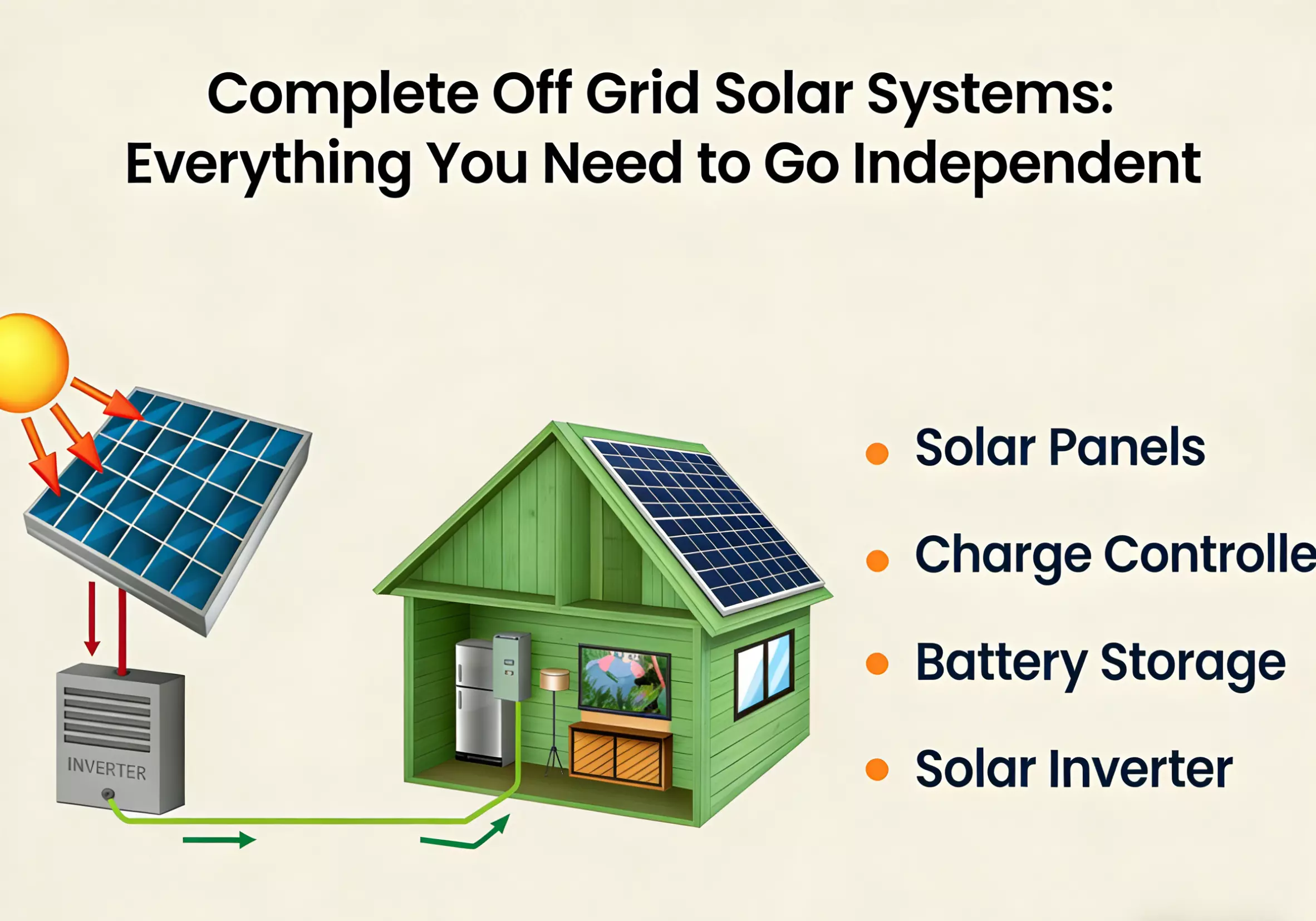
Imagine: the electricity at home comes entirely from the sun, no longer bound by the electricity bill, and there is no need to worry about sudden power outages. The off-grid solar system is the key solution to make this lifestyle possible. It is not only a power supply system, but also a choice to move towards independent energy use and sustainable life. This guide will take you to a comprehensive understanding of the core concepts and construction methods of off-grid solar energy from a practical perspective, and help you control your own energy future step by step.
Why has the off-network system become the choice that more and more people are paying attention to?
"Off-Grid power supply" has gradually become mainstream from minority choices. Whether in North America, Europe, Australia or some Asian countries, more and more families have begun to seriously consider the configuration of complete solar systems for Off grid. The reason is actually very simple:
1. The actual needs of unstable power grid coverage, rural and remote cottages
In many areas, power grid construction is outdated or undercovered, and power outages have become a part of residents' lives. For farms, cottages, woodlands, islands and holiday homes, pulling cables is not only expensive, but sometimes even impossible to achieve.
2. Frequent power outages and increasing natural disasters make "backup + self-supplency" become a rigid demand.
Power outages caused by extreme weather such as storms, extreme high temperatures, blizzards and wildfires are on the rise. People began to realize:
Having your own energy system is more solid than anything else.
3. Photovoltaic price decline + mature energy storage technology = off-grid system is more feasible
The cost of solar modules has dropped by more than 70% in the past 10 years. LFP energy storage battery life is getting longer and longer, and the price is more and more affordable, so that the all-inclusive off-grid solar package is no longer a luxury. And it has become a long-term investment that ordinary families can afford.
In short:
Independent power supply is not a trend, but a trend.
What core components are included in the off-grid solar system?
The complete full off-grid solar setup is usually composed of 6 core parts:
1. Solar panel (PV)
Responsible for converting sunlight into direct current (DC).
Including: single crystal, double glass, double-sided, high-efficiency N-type, etc.
2. Energy Storage Battery
The brain and heart of the off-net system.
Common types include:
Lead-acid (AGM / GEL)
Lithium-ion
LiFePO4, lithium iron phosphate (the most mainstream in 2025)
3. Inverter
Convert DC into AC for home appliances.
Off-network systems usually need:
✔ Pure sine wave inverter
✔ Off-grid inverter or hybrid inverter (support solar energy + battery + power/generator)
4. Charging controller (MPPT)
Keep the photovoltaic current within a safe range to improve power generation efficiency.
MPPT can increase power generation by up to 20-30%.
5. Power distribution devices and safety components
Including:
Circuit breakers, fuses, DC/AC distribution boxes, lightning arresters, grounding, cables, joints, etc.
6. Installation structure
Roof bracket, ground bracket, waterproof box, support structure, etc.
How to evaluate your electricity consumption and energy storage needs (the starting point of off-network system design)
The first step of off-network design is always:
First, calculate how much electricity you need.
1. Make a list of daily electricity equipment
For example:
Refrigerator
Router
Microwave oven
Illuminate
Water pump
Water heater
Washing machine
Computer/TV
Then record the unit power (W) and usage time (H) of each device.
2. Calculate the daily power consumption (kWh)
Formula: W × Hours of Use ÷ 1000 = Daily Power Consumption kWh
3. Calculate the instantaneous peak power
If there is an instantaneous current shock when the refrigerator starts and the motor starts, the inverter must be able to withstand it.
4. Consider the number of alternate days
It is usually recommended that the energy storage capacity is 1.5–3 days of electricity consumption to ensure that basic life can be maintained on continuous rainy days.
Choose the appropriate off-grand configuration according to the needs (three schemes: high, medium and low)
Scheme A: Basic Home / Cottage Backup System (Low-cost Entry-level)
Applicable objects:
Occasional cottages, holiday homes, remote farms, emergency standby.
Configuration suggestions:
Solar panel: 800W–1500W
Battery capacity: 2–5 kWh LiFePO4
Inverter: 1.5–3kW pure sine wave
Suitable for basic lighting, routers and small household appliances
Advantages: The cost is low, and the basic life is completely sufficient.
Scheme B: Independent House / Farm Family (Medium Size)
Applicable objects:
Residential scenes that require 24-hour stable power supply.
Configuration suggestions:
Solar panel: 3–6 kW
Battery: 10–20 kWh
Inverter: 5–8 kW
It can support refrigerators, water pumps, microwave ovens, washing machines, etc.
Suitable for long-term self-sufficiency.
Scheme C: Fully off-network self-sinsiencing system (advanced scheme)
Applicable to:
Small houses, areas without municipal electricity, farms and holiday homes that are completely self-supported all year round.
Configuration suggestions:
Solar panel: 8–12 kW
Battery pack: 20–40 kWh (or more)
Inverter: 8–12 kW
Support generator/wind energy hybrid mode
It is suitable for users who want to get rid of the power grid completely.
Choose batteries, inverters and panels: how to choose without stepping on pits?
1. Key factors in battery selection
LiFePO4: Long life, highest safety, 4000+ cycles, most suitable for off-grid
Lead acid: cheap but short life (300–600 times)
Capacity: at least cover the electricity demand for 1.5–3 days
Voltage: 48V is more efficient than 12V/24V
BMS (Battery Management System) must be reliable.
It is better to support serial and parallel expansion.
Pay attention to temperature performance (low-temperature charging limit)
2. Inverter Selection Guide
Key indicators:
Pure sine wave
Continuous power ≥ 1.2–1.5 times the peak demand
Efficiency ≥ 90%
Support solar energy + battery + generator
UPS switching speed < 10ms
Does it support WiFi monitoring?
Whether it can be expanded and parallel
3. Points to pay attention to in the selection of solar panels
The higher the wattage of the panel, the more cost-effective (550W / 600W large board gradually becomes mainstream)
South-facing installation, inclination 25°–35°
Prevent cover
Winter low light compensation
Installation, maintenance and security suggestions for off-network systems
1. Device protection
Waterproof and dustproof level at least IP65
Must be grounded and lightning-proof
The cable must be sheathed to prevent aging.
The battery should be placed in a well-ventilated place.
2. System inspection and maintenance
Check the wiring and tightening every 3–6 months
Clean the panel dust regularly
Monitor the temperature of the inverter
Avoid deep discharge of the battery (not recommended to be less than 10%–20%)
Economic Analysis: Cost vs Long-term Income
Off-network systems often have high initial investment, but in the long run:
No more electricity bills
Reduce the impact of power outages
Long device life (LFP up to 10–15 years)
It is cheaper to pull the power grid in remote areas.
Especially for LFP batteries, the cost per kWh Cycle is much lower than that of lead-acid.
Common misunderstandings (pits that many users have stepped on)
Insufficient configuration: the panel is too small and the battery is too low
The inverter peak is not enough.
The installation position is damp or closed, causing the inverter to overheat.
Mix and use different brands of batteries
Buy the system without evaluating the electricity consumption.
Just look at the price, not the life and safety.
Intelligent, modular and hybrid energy will become the mainstream.
In the future, off-network systems will be more intelligent and expandable. Trends include:
Sodium ions and solid-state batteries
Higher density LiFePO4
Hybrid inverter + EMS integration
Solar energy + wind energy + energy storage combination
Home microgrid
Modular stackable battery
Choosing a complete off-line system suitable for you is a wise long-term investment.
The off-network system is not impulsive consumption, but a long-term choice to improve the sense of security, sustainability and independence of life.
If you are looking for:
Ready-to-install off-grid solar system (a complete set of off-grid system that can be installed directly)
Complete independent power supply scheme
Suggestions for solar energy configuration for RVs, cottages and farm families