
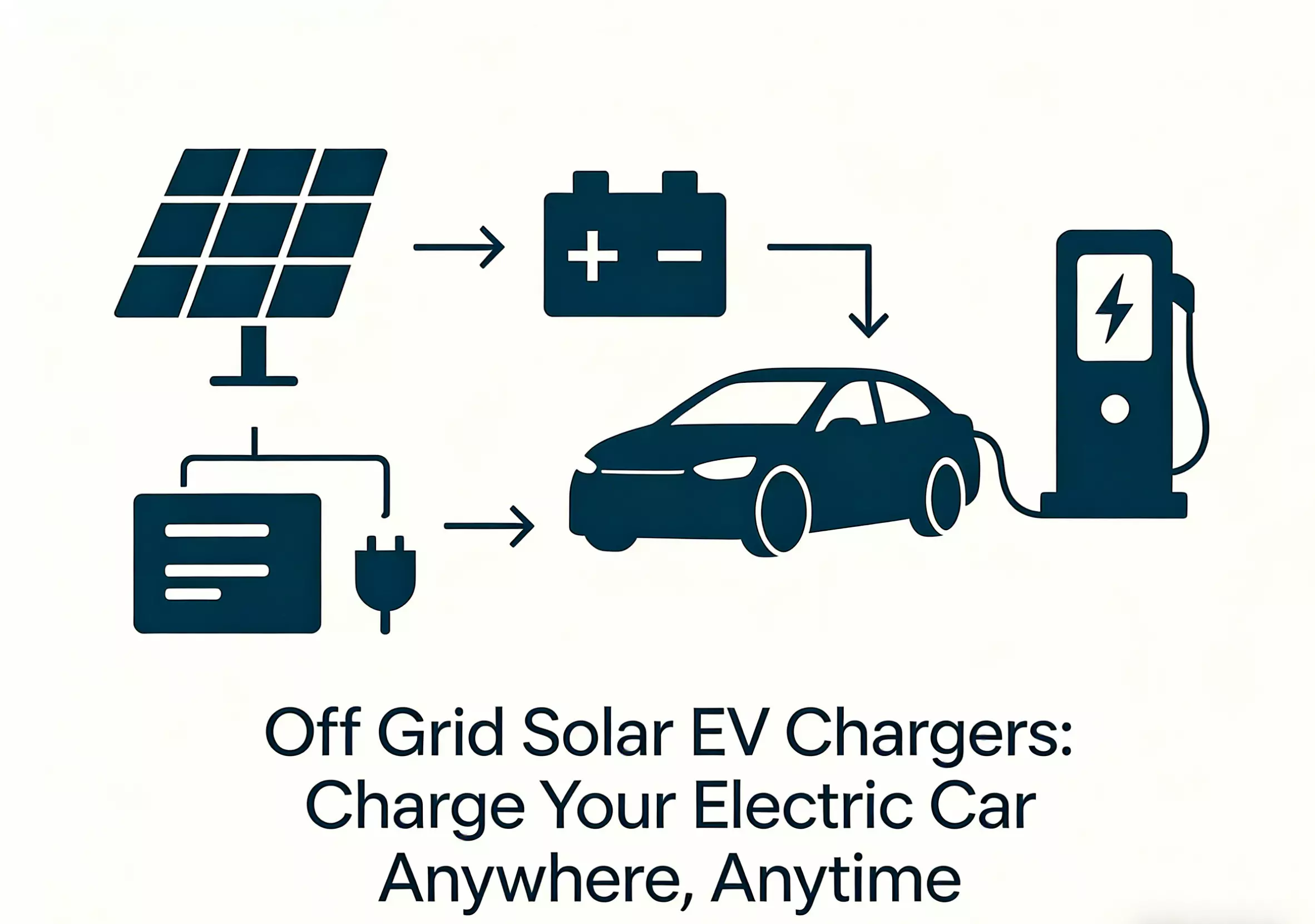
Electric vehicles are becoming a common mode of transportation, but the charging infrastructure has yet to catch up with actual usage needs. While cities enjoy dense networks of charging stations, many areas remain poorly served or completely off the power grid.
Remote residences, rural properties, forest cabins, campsites, RV parks, disaster relief areas, and construction or mining sites often lack dependable grid access for charging. In these places, the concern isn’t just convenience but whether charging is even possible.
Meanwhile, off-grid living, energy self-sufficiency, and mobile solar power systems are attracting worldwide interest. This leads to a practical and increasingly frequent question: can off-grid solar setups reliably charge electric vehicles under real-world conditions?
Is Off-Grid Solar Charging for EVs Practical?
Charging electric vehicles using off-grid solar power is possible, but only if specific engineering criteria are fulfilled. Many sources claim it can be done without detailing the necessary conditions, which can create unrealistic expectations.
Charging an EV requires a continuous, high-power electrical supply. Systems designed for lighting or household appliances often fall short for vehicle charging. Practical success depends on the system’s size, energy storage capacity, and power quality.
Key Requirements for Off-Grid EV Charging
Adequate Solar Generation Capacity
Electric vehicles use much more energy than typical household devices. While a small appliance might draw high power briefly, EV charging demands sustained power over several hours.
Solar arrays that are too small might technically produce electricity but won’t support effective vehicle charging. For off-grid EV charging, solar panel capacity must be planned based on daily energy needs rather than theoretical maximum output.
Energy Storage Is Crucial
Solar energy is inherently intermittent, fluctuating with the time of day, weather conditions, and seasons. However, EV chargers need a stable and continuous power supply.
Without batteries, charging can be easily disrupted by passing clouds or fading sunlight. Energy storage is not just an optional upgrade but a fundamental part of any off-grid EV charging system.
Inverter and Charger Compatibility
Electric vehicles require stable voltage and high-quality power waveforms. Off-grid inverters must provide a clean, pure sine-wave output with adequate continuous and surge power capacity.
Even if solar panels and batteries are sufficient, an incompatible inverter can prevent charging altogether. Ensuring proper compatibility among the inverter, charger, and vehicle specifications is essential.
What Off-Grid Solar EV Charging Can Accomplish
Off-grid solar setups are ideal for regularly replenishing energy rather than quickly charging an EV from empty to full. They facilitate slow, controlled AC charging and work best in fixed or semi-mobile settings.
These systems are not intended to match the capabilities of high-power DC fast charging stations. Trying to provide ultra-fast charging off-grid demands system sizes that are usually neither cost-effective nor practical.
How an Off-Grid Solar EV Charging System Operates
A standard system follows a clear energy flow:
Solar panels produce electricity, which is managed by an MPPT charge controller. This energy is stored in batteries and then converted by an off-grid inverter into stable AC power suitable for EV chargers.
Energy management prioritizes using solar power directly while storing any surplus for later use. This scheduling ensures steady operation despite changing solar conditions.
The Importance of Batteries in the System
Without batteries, fluctuations in solar power directly impact charging stability. Adequate storage allows the system to support charging at night, during cloudy weather, and maintain consistent power output.
In EV charging applications, batteries are more than just backup—they form the essential foundation that enables dependable charging performance.
Typical Energy Requirements
Electric Vehicle Battery Sizes
| Vehicle Type | Battery Capacity |
|---|---|
| Compact EV | 35–45 kWh |
| Family EV | 50–75 kWh |
| Large SUV or Pickup | 80–100+ kWh |
Off-grid systems usually aim to replenish 10 to 20 kWh per day, which supports regular commuting or short-distance travel.
Example of Solar and Battery Sizing
To meet a daily energy goal of 15 kWh with an average of five effective sunlight hours, the theoretical solar panel capacity needed is about 3 kW. However, in real-world conditions, systems sized between 4 and 6 kW are recommended to provide necessary backup.
Battery storage is generally advised to be between 20 and 40 kWh to maintain stable charging and handle fluctuations in weather.
Essential System Components
The main parts consist of high-efficiency monocrystalline solar panels, lithium iron phosphate batteries known for safety and long lifespan, pure sine-wave off-grid inverters, and AC chargers for electric vehicles.
For medium to large setups, an energy management system enhances performance by managing power generation, storage, and charging demands.
Ideal Use Cases
Off-grid EV charging works well for remote residences, cabins, RVs and camping sites, emergency response units, and small charging stations at eco-resorts or rural locations.
In these situations, being independent from the electrical grid ensures reliability and offers long-term cost benefits compared to diesel generators.
Costs and Limitations
The initial cost covers solar panels, battery storage, inverter equipment, and supporting structures. Although the upfront expense is higher than traditional generators, operating costs are much lower since there is no fuel needed and maintenance is reduced.
Typical errors include overestimating how fast charging can occur, underestimating seasonal changes in solar availability, and having too little battery capacity.
Summary
Off-grid solar EV chargers are established, reliable energy solutions when designed and used appropriately. They are not meant to replace fast public charging stations but provide a dependable option for energy-independent transportation.
In suitable scenarios, off-grid solar charging eliminates reliance on the grid, lowers ongoing costs, and allows electric vehicles to operate well beyond the limits of conventional infrastructure.