
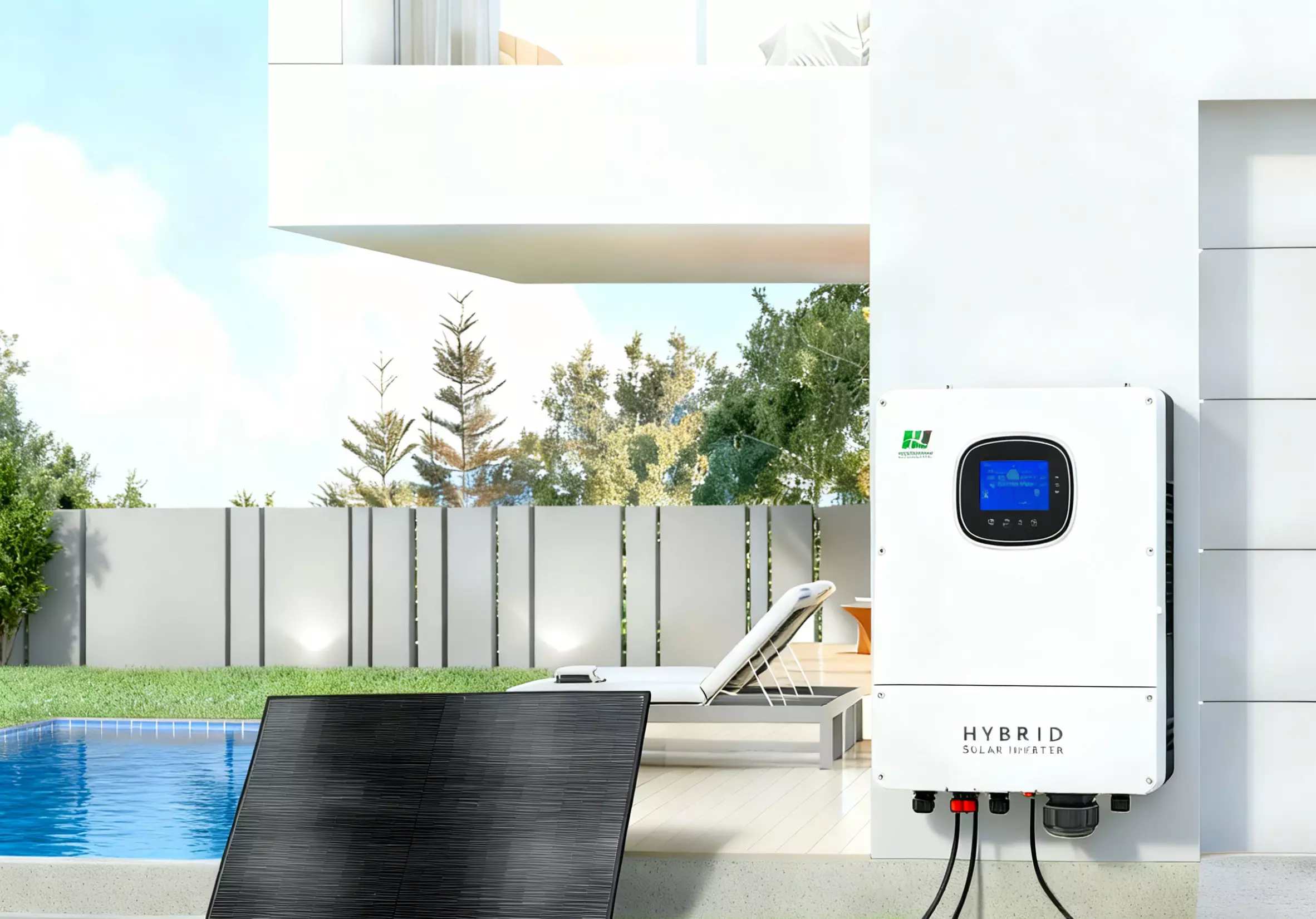
Many users tend to focus on solar panels or battery capacity when they first come into contact with off-grid systems, but in fact, choosing the right inverter is often more important than installing a few more solar panels. The inverter not only determines the efficiency of power generation conversion, but also affects the life of home appliances, the experience of electricity consumption and even the stable operation of the system.
This article will take you step by step to understand what off grid solar inverter is, its role in the system, and how to choose the most suitable one according to the real needs of the family. At the same time, we will also give some calculation methods in combination with the real household electricity scene, and provide you with real selection suggestions.
Why is it so important to choose Off Grid Solar Inverter?
In the past few years, the number of users who choose to establish a home off-line power supply system has increased rapidly. The reason is not difficult to understand:
Limited power grid coverage in remote areas
Frequent power outages affect the quality of life.
Families hope to reduce their dependence on traditional electricity.
Concerns about the long-term rise in energy costs
Or just want to achieve a greener and more controllable lifestyle.
But in the off-grid scenario, you can't rely on the public power grid to stabilize the voltage and frequency, so the inverter plays a key role:
It is not only responsible for converting direct current into alternating current, but also assumes the function of "system dispatch center".
When the inverter is not selected properly, it will appear:
✘ Home appliances start tripping
✘ Low system efficiency
✘ Shortened battery life
✘ No electricity at the critical moment
✘ The system frequently alarms or even damages
Therefore, for any user who wants to achieve energy independence, choosing the right off grid solar inverter is the most critical first step.
What Is an Off-Grid Solar Inverter?
1. Basic working principle
The core of the off-grid inverter is to convert the direct current (DC) of solar modules and battery output into alternating current (AC) available at home.
It is not only a "converter", but also a "dispatch center" of the whole system, responsible for:
Control photovoltaic power generation
Charge the battery
Protect household appliances from abnormal voltage damage
Output stable pure sine wave power
Ensure that the family does not have power in extreme cases.
2. Differences from other types of inverters
| Grid dependence | Off-grid capable | Inverter type | Functional features |
| Needs grid | × Cannot | Grid-tie | Feeds power to the grid only |
| Needs grid (varies by brand) | ○ Limited | Hybrid | Supports grid-tied & off-grid, but off-grid performance differs by brand |
| No grid required | √ Fully | Off-grid | Stand-alone supply, autonomous battery management, stable independent output |
For families who want to build a pure off-grade system, standalone solar inverter is the best choice.
Key Factors to Consider When Choosing an Off-Grid Inverter
1. Rated Power Output
This is the most direct parameter when selecting off grid solar inverter.
The higher the rated power, the more household appliances can be driven at the same time.
How to calculate the power required by the family?
Just add up the power of all the household appliances that may be used at the same time.
The following is an example of a typical family scenario:
| Appliance | Power (W) |
| Refrigerator | 150 |
| Television | 120 |
| Laptop | 80 |
| Washing Machine | 500 |
| Air Conditioner | 1200 |
| LED Lighting | 60 |
| Water Pump | 800 |
General suggestions:
Household demand = total power × 1.2 safety factor
For example:
3000W × 1.2 ≈ 3600W inverter start
Therefore, most independent houses usually choose 5kW-12kW off grid solar inverters.
2. Surge power
Some household appliances require several times the power at the moment of start-up, such as:
Refrigerator, air conditioner: 3–7 times
Water pump: 3–4 times
Electric motor equipment: large instantaneous impact
If the inverter does not support the startup peak, it will:
✘ Failed to start
✘ Inverter alarm
✘ Even burn electronic components
Typical peak reference table:
| Appliance | Rated Power | Start-up Multiplier | Peak Power |
| Air-conditioner | 1,200 W | × 5 | 6,000 W |
| Refrigerator | 150 W | × 3 | 450 W |
| Water pump | 800 W | × 3 | 2,400 W |
Therefore, a qualified off-grid power inverter should at least have:
Starting capability of 1 times the rated power + 3~5 times the peak power
- Battery Compatibility
Why is battery compatibility so important?
Because the battery is the "energy warehouse" of the entire off-grid system.
(1)LiFePO4 vs Lead-acid
| Battery Type | Cost | Life Span | Depth of Discharge | Maintenance | Recommended |
| Lead-acid / Carbon-lead | Low | 3–5 years | ~50 % | Required | Fair |
| LiFePO₄ (Lithium Iron Phosphate) | Medium | 10–15 years | 80–95 % | Almost maintenance-free | Highly recommended |
For a truly stable and worry-free off-network system, LiFePO4 is the best choice.
(2) Does it support BMS communication?
An excellent off grid solar inverter must support:
✔ BMS communication
✔ Overcharge and over-release protection
✔ Intelligent charging and discharging mode
Otherwise, the battery life will be greatly shortened.
(3) 48V vs 24V system
Simple suggestions:
Small off-grille system (<3kW) → 24V
Home system (>5kW) → Choose 48V for safer and more efficient
4. Pure Sine Wave vs Modified Wave
It must be emphasized that:
Pure Sine Wave inverters must be selected for home off-grid systems.
The reason is very simple:
✔ Protect household appliances
✔ Higher efficiency
✔ Lower noise
✔ Traditional household appliances (refrigerator/air conditioner/motor) run more stably
The wave-changing inverter is only suitable for very simple DC load systems and is not suitable for long-term home use.
5. MPPT Controller Integration
Recommended choice: hybrid off-grid inverter integrated with MPPT
Advantages include:
Higher efficiency (up to 99.9%)
The system is more compact
Easier to install
More photovoltaic modules are adapted to a higher voltage range
The wider the voltage range of MPPT, the higher the flexibility of photovoltaic panels in series.
6. Efficiency & Protection Features
You need to pay attention to the following aspects:
Conversion efficiency ≥ 95% (the higher the power saving)
Short-circuit protection
Over-temperature protection
Overcurrent protection
Lightning protection
High-quality solar inverter for off-grid homes will provide full-link protection from hardware to software.
7. Expandability & Parallel Function
When family demand grows, you will hope that the system can:
✔ Support capacity expansion
✔ Support parallel machine
✔ Support larger photovoltaic arrays
Choose an inverter that supports parallel machines = future upgrades will save more money.
Common Mistakes to Avoid When Choosing an Inverter
Avoiding the following common mistakes can help you save a lot of costs:
Only look at the power, not the start-up peak.
The battery does not match the inverter.
Ignore MPPT specifications
Forget to consider the future capacity expansion.
Choose a cheap inverter without certification
Neglect after-sales and technical support
Best Use Cases for Off-Grid Inverters
The following are the most common usage scenarios for off-grid inverters:
RV and RV (independent power supply)
Residences in remote areas (villages/mountains without power grids)
Farms and pastures (irrigation, water pumping, lighting)
Island and independent cottage
Outdoor temporary engineering project
Household emergency backup power supply (disaster backup)
No matter where you are, as long as you want to "use electricity without looking at other people's faces", off-grid inverter is worth your investment.
Twobest off-grid solar inverters
The following products come from LZY Energy, which are suitable for home off-network systems of different sizes.
⭐ 8kW–11kW Single Phase Off-grid Inverter
Product highlights
Advanced MPPT technology, with an efficiency of up to 99.9%
Maximum photovoltaic input current 22+22A
Output pure sine wave AC current
The maximum load-bearing load is 72kW
Industrial design appearance, simple installation
Support up to 260A charging current
Support LiFePO4 BMS communication
Support water pump irrigation linkage
Suitable for: ordinary independent residences, families in remote areas, and independent power supply systems for farms.
⭐ 10–12kW three-phase low-voltage Off-grid Inverter
Product highlights
High-quality three-phase pure sine wave output
Suitable for large units and high-power equipment
Integrated design, high degree of automation
Support LiFePO4 & BMS communication
Powerful peak start-up ability
Expandable capacity and can be merged
Conclusion
Choosing a suitable off grid solar inverter is to choose:
More stable household electricity
Longer-lived household appliances
A safer energy system
A more independent and controllable lifestyle
If you are looking for a high-quality inverter suitable for home off-network systems, welcome to check our product page or contact us directly for a quotation.