
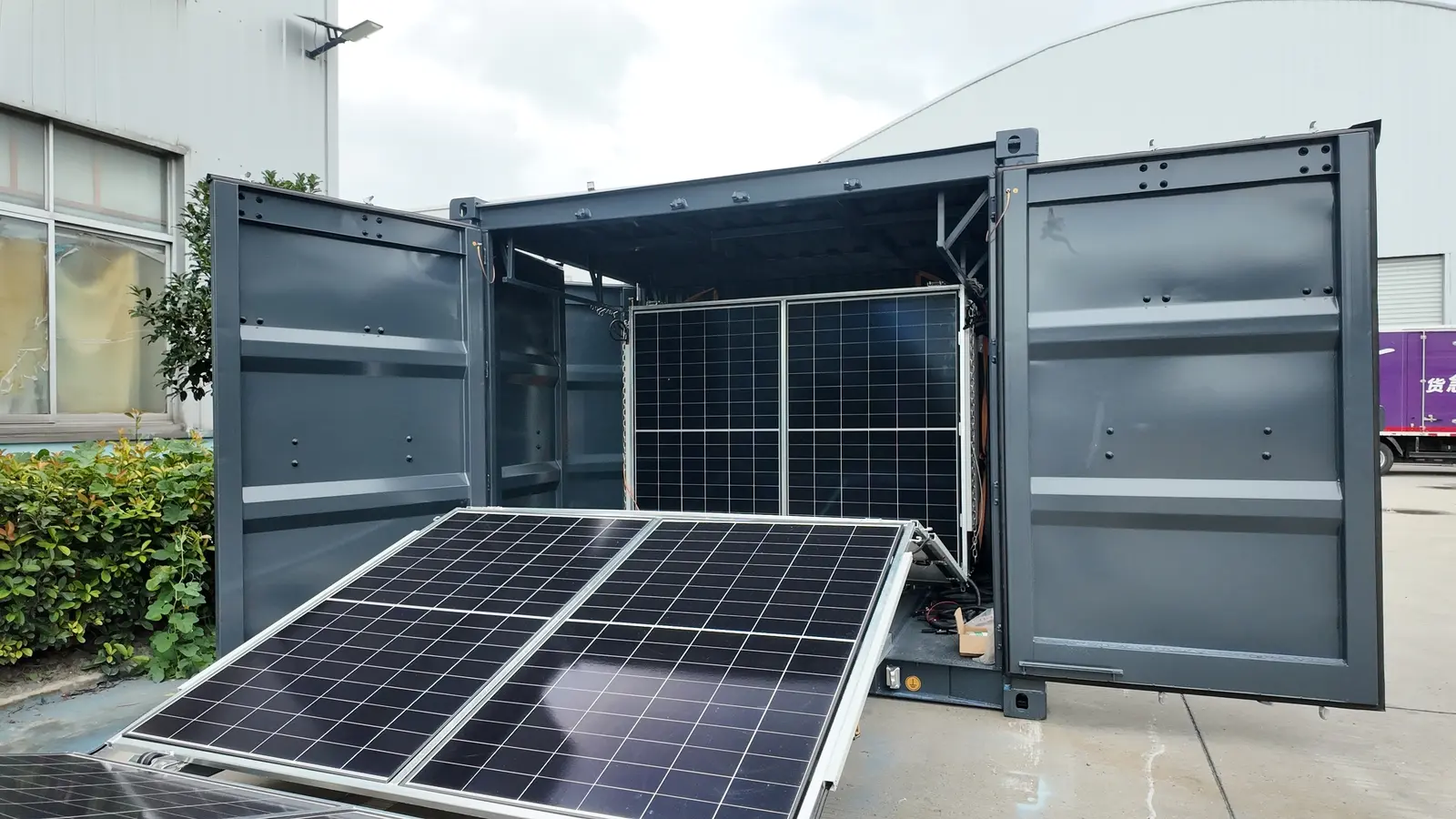
As the need for energy grows within the context of remote workplaces, construction sites, emergency response operations, and off-grid settlements, installing fixed solar arrays is not always convenient. Fixed solar arrays require a foundation to be installed and take up time for preparation and assembly.
There exists an alternative of deploying mobile deployable solar arrays that integrate photovoltaics, energy storage and energy conversion equipment in order to generate electricity on-site. Solar containers combine all these features by adding mobility and rapid deployment capabilities.
What Is a Mobile Deployable Solar Array?
Mobile deployable solar array is a portable photovoltaic power system which can be transported and assembled in various locations.
In contrast to fixed ground-mounted solar power stations which have a rigid structure, mobile solutions utilize foldable, retractable, or modular mounts. Photovoltaic panels can be stored compactly and deployed upon arrival.
There are several key elements common for most of the mobile solutions:
- Solar panels: convert sunlight into DC energy.
- Mounting structures: support the panels and allow them to be deployed or folded.
- Battery storage: store extra energy for nights or cloud-covered days.
- Power conversion system: convert DC energy into AC electricity.
- Energy Management System (EMS): monitor energy production, consumption, state of batteries and work of the entire system.
How does a Solar Container work?
Solar container is a portable power system, which unites photovoltaic modules, battery storage, inverters, and electrical control systems within a containerized structure. It provides a mobile solution to the construction of a solar power plant without any permanent installation.
The process involves four stages:
1. Transport
The container is transported to the project site with the help of standard logistic equipment, adjusted according to its design and dimensions. The compact design of the container makes its transportation easier.
2. Deployment of Solar Panels
After the delivery, the photovoltaic panels are deployed by means of the deployment system. There are two types of such systems – manual and hydraulic/electric deployment systems.
3. Electricity Production and Storage
During the day, the panels produce electricity. The output is controlled by the power conversion system and can be used to power up the connected loads and to charge the battery.
4. Power Supply
The stored electricity allows for supporting loads after sunset.
In practice, the EMS controls solar production, battery charging, and electricity supply.
Advantages of Mobile Deployable Solar Arrays
There are many benefits associated with mobile deployable solar arrays. They compensate for the drawbacks that regular installations have.
Quick Installation
One of the main benefits is flexibility in installation. There is less necessity for on-site assembling since all the parts of equipment are integrated beforehand, which makes installation process quicker than in case of traditional solar installation depending on the system and site features.
Variable Power Capacity
Mobile deployable solar array has different photovoltaic capacity and batteries. Therefore, mobile solar array may vary from small temporary facilities to bigger power needs used for commercial and industrial purposes.
Decreased Use of Diesel Generators
Many remote facilities use diesel generators in order to provide power where electricity from the grid is not available. The cost of fuel delivery, maintenance, and operation increases rapidly. Mobile solar container can decrease generator operational hours, because renewable energy will be produced during the day and stored in batteries for usage at night.
Reusability and Relocation Ability
Mobile facilities can be relocated easily according to new project requirements. In addition, construction company does not have to install solar system at each facility separately.
Integrated Energy Management
Due to integration of renewable energy production, storage, and management system it is possible to use different energy sources efficiently.
Where Are Solar Containers Used?
Solar containers work best at sites where there is poor access to grid electricity, or when temporary power infrastructure is needed.
The following are typical uses of solar containers:
Construction Sites
Some construction sites are located in areas where there is little grid connection. The solar containers can provide electricity to such sites for various purposes including lighting and running of equipment.
Mining and Industrial Operations
Remote mining and industrial centers often have diesel generators. Using solar generation and battery storage systems will help reduce the usage of diesel while maintaining flexibility of the electricity source.
Emergency Response
In cases where there has been damage to the infrastructure due to disasters, the mobile solar containers can help in providing the power that will be necessary for communication, lighting, etc.
Telecommunications
Remote telecom stations always need some power sources to maintain their connectivity. The solar containers can be used alongside battery storage and backup generators to provide necessary power.
Outdoor Exhibitions, Temporary Events and Camps
Temporary exhibition events, outdoor camps, etc., may use the mobile solar system to lessen reliance on conventional generators.
Mobile Solar Array vs. Traditional Solar Installation
Although both systems use photovoltaic technology, their designs and applications are different.
| Comparison | Mobile Solar Array | Traditional Solar Installation |
| Installation | Designed for rapid deployment | Requires permanent installation |
| Mobility | Transportable and relocatable | Generally fixed |
| Structure | Foldable or modular | Fixed mounting structure |
| Site preparation | Usually limited | Often requires more preparation |
| Application | Temporary and remote projects | Long-term power generation |
| Expansion | Depends on modular design | Depends on available land and infrastructure |
It is important to understand that mobility does not automatically mean unlimited flexibility. Actual deployment speed, power capacity, and relocation requirements depend on the mechanical structure, container dimensions, and electrical configuration.
Selection of Appropriate Solar Container
Choosing the mobile solar power system does not only depend on photovoltaic capability. It requires taking into account the full power consumption and working environment.
What should be considered when selecting a proper system?
- Power Consumption: Estimate the connected load and consumption of electrical power per day. It defines the necessary capacity of solar generation.
- Batteries Capacity: Consider for how many hours the system can function without enough solar irradiance. The battery capacity should match this backup period.
- Deployment Concept: Plan whether your preference will include folding panels, extensible structure, or modular design. Consider the transportation dimensions and installation environment as well.
- Working Environment: Such factors as temperature, wind, dust, humidity, and solar radiation affect system performance. Equipment should be protected appropriately for the installation site.
- Energy Management System: A good EMS is capable of synchronizing PV generation, batteries charging, load balance, and backup sources.
In case of constant power supply, it might be more appropriate to select the hybrid system (solar, storage, and diesel generator).
LZY Energy’s Mobile Solar Container Systems
At LZY Energy, the mobile solar container solutions we offer are created with the aim of providing flexible solutions for power production and energy storage.
The foldable solar container contains photovoltaics, a battery bank, and power conversion equipment. Being deployable, the solar panel will expand at the site but will remain compact when moving.
Various setups can be offered depending on the demands of the specific project:
- Photovoltaic generation range from 20 to 200 kWp
- Batteries from 100 to 500 kWh
- Power converters and energy management systems
- Various modular setup for different conditions of operations
- Hybrid systems, where additional power source is needed
This type of setup is suitable for remote industrial sites, constructions, temporary campsites, and places that have limited access to the electric grid.
From the point of engineering, an important question would be the alignment of solar generation with the electricity consumption. More photovoltaics does not automatically mean good performance. Matching correctly photovoltaics and loads with a battery bank is crucial for efficient performance.
Conclusion
Solar power through portable and flexible solar arrays is a way forward in the quest for renewable power where permanent stations would either be impossible or unnecessary. It becomes possible due to integration of foldable solar panels with battery storage and intelligent management of power supply by solar containers.
Where temporary energy generation or remote energy operation is involved, using the right solar container will reduce the need for diesel fuel as well as power station setup while providing renewable power.
LZY Energy provides mobile solar container solutions with flexible power and storage configurations. Contact our team to discuss a system tailored to your project requirements.