
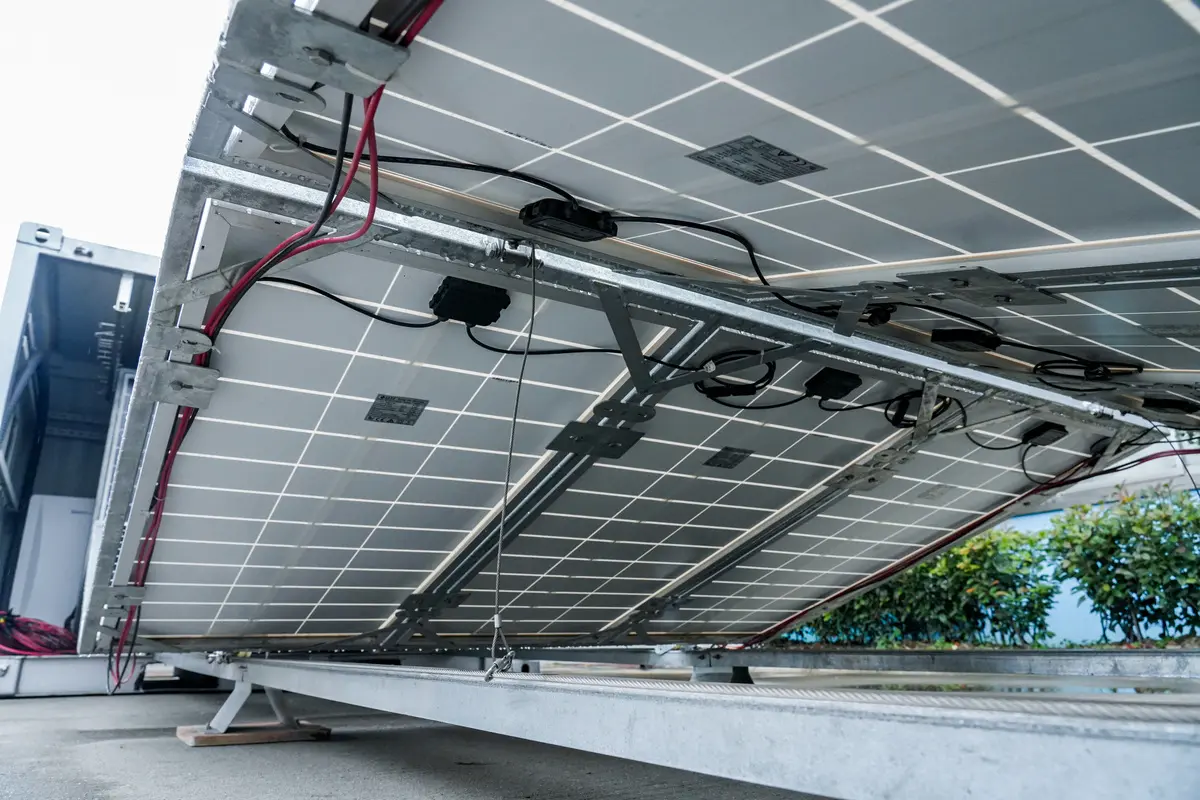
For European solar projects, among the most affordable ground mount solar racking systems are those produced by Chinese manufacturers. The current public suppliers' list includes ground mount systems based on basic galvanized-steel at around €0.016–€0.022/Wp and aluminum systems starting from approximately €0.026/Wp. However, these are factory-level references and not the cost of a mounted solar system in Europe.
How Expensive Are Chinese Ground-Mount Racking Systems?
Chinese suppliers have a competitive edge in solar mounting structures due to the mass-production, mature supply chain and competition among suppliers.
Current public suppliers' list gives some useful references:
| Racking type | Public Chinese supplier price | Typical material |
|---|---|---|
| Basic steel ground mount | From about €0.016/Wp | Galvanized steel |
| Pole-type steel mount | From about €0.022/Wp | Galvanized steel |
| Aluminum ground mount | From about €0.026/Wp | Aluminum |
| European delivered project | Higher | Depends on freight, duties, installation |
For instance, Xiamen Large Energy offers a galvanized-steel ground mounting system at approximately €0.0157/Wp, including a 12-year product warranty, 216 km/h wind load capacity and 1.5 kN/m² snow load capacity.
Huge Energy offers a galvanized-steel pole ground mounting system from approximately €0.0215/Wp, including the 3.6 kN/m² snow load capacity.
An aluminum ground mount system by Soeasy is offered from approximately €0.0264/Wp.
These figures demonstrate the benefits of buying ground mount racks from China.
There is, however, a point to keep in mind: €0.016/Wp is not equal to €0.016/Wp of the installed solar system in Germany, France, Italy, Spain or the Netherlands.
What Does the Factory Price Include?
Low Chinese factory quotation may include basic mounting structure components such as:
- Posts
- Rails
- Brackets
- Module clamps
- Fasteners
- Structural connectors
Depending on the supplier, it may be quoted on EXW or FOB basis.
The European customer will probably have to pay for:
- Ocean or rail freight
- Insurance
- Port handling
- Customs clearance
- Import taxes if any
- Inland transportation
- Local engineering
- Foundation
- Installation labor
- Project-specific certification or documentation
This explains why comparing two suppliers by their €/Wp quotation may lead to a wrong conclusion.
Steel or Aluminum Which Is Cheaper?
For the cost-sensitive ground-mounted projects, galvanized steel may be the first choice to consider.
Steel is highly structural and may be more cost-effective for larger arrays. On the other hand, aluminum is light and has excellent corrosion resistance, but it may be more expensive in terms of the material cost.
The right choice depends on the project.
For example, if the European project location has high wind loads or heavy snow, using more material may be needed regardless of what the mounting structure is made of.
The cheapest mounting structure is not the one that uses the least amount of material.
It is the one that meets the required structural loads without overengineering.
Fixed Tilt Is Usually the Most Cost-Effective Option
If the goal is to reduce the cost of ground mounting, fixed tilt systems are usually the simplest solution.
They do not require:
- Motors
- Tracking controllers
- Gearboxes
- Moving structural parts
- Tracking maintenance
The panels will stay at the fixed angle throughout the year.
For many European commercial, agricultural or utility-scale projects, fixed mounting will provide a reasonable compromise between cost, reliability and energy production.
Tracking may produce more electricity, but the additional hardware and maintenance have to be justified by the extra generation.
Don’t Forget About European Project Requirements
The Chinese factory will be able to manufacture the same basic rack for the project in Spain or Sweden, but the engineering requirements may vary greatly.
European projects may need to take into account:
- Local wind speeds
- Snow loads
- Soil conditions
- Ground frost
- Corrosion environment
- Panel sizes
- Installation requirements
- Local structural requirements
For example, mounting structure designed for the low-snow Mediterranean location cannot be just copied for the European project in the north.
The supplier has to receive the information about the project location and engineering requirements before developing the mounting structure.
The Cheapest Rack Is Not Always the Cheapest Solar System
This is especially important for customers looking for the complete solar solution.
Let us assume that a European developer purchases a 500 kW ground mount structure from China for approximately €0.02/Wp.
The factory-level mounting cost will be:
500,000 W × €0.02/W = €10,000
This figure sounds extremely inexpensive.
However, the €10,000 does not cover the entire solar installation.
The project still needs to purchase solar modules, inverter, electrical protection, cables, foundation, transport, labor, commissioning and potentially energy storage.
This is when the idea of the complete solar system becomes more appropriate.
When a Mobile Solar System Makes More Sense
Not every European project needs a permanent ground-mounted solar array.
Consider a construction site, temporary agricultural facility, remote industrial project, or mobile power application.
Building permanent foundations for a system that will later be dismantled can create unnecessary costs.
This is where LZY Energy's mobile folding solar container offers a different approach.
Instead of supplying only solar racking, LZY Energy integrates the solar panels, folding support structure, container, inverter, electrical equipment, and optional energy storage into one complete system.
The solar panels are connected to folding structures that can expand during operation and fold into a compact configuration for transportation.
The entire unit can therefore move with the project.
Why the Folding Solar Racking Is Different
The folding structure still fulfills the basic function of solar racking.
It supports the PV modules and keeps them in their operating position.
But it addresses another issue - transportation.
Ground mounting is optimized for the permanent installation.
LZY Energy's folding racking is optimized for:
transport → deployment → generation → folding → relocation
Therefore, it becomes especially interesting for those projects where the solar system cannot stay permanently at one place.
Instead of purchasing cheap racks and then spending money for dismantling and rebuilding them, the customer buys a complete mobile generation system which is developed for relocation from scratch.
China Supplier, European Project
For European customers, a Chinese supplier can provide the significant equipment cost advantage, but the supplier has to understand the project requirements first in order to provide the final quotation.
I would recommend to provide the following information:
- Project country
- Project location
- PV capacity
- Solar module model
- Ground conditions
- Wind load
- Snow load
- Required tilt angle
- Fixed or mobile application
- Delivery destination
- Required certifications
- Installation inclusion or not
This way, the manufacturer can provide a much more realistic system quotation.
Besides, EU trade requirements should be considered for the exact product and its customs classification. According to the European Commission, anti-dumping measures may be applied to certain imported products provided that certain investigation and legal conditions are fulfilled, while the 2026 CBAM definitive regime applies to specified CBAM goods and not to every imported product.
Ground Mount or Mobile Solar Container?
The decision here is quite straightforward.
Conventional ground mounting should be selected when:
- The project is permanent
- There is enough land
- The system will operate for many years
- Foundation construction is possible
- The lowest fixed installation cost is the priority
The mobile folding solar container should be selected when:
- The project is temporary
- The power system requires relocation
- The site is remote
- The quick deployment is important
- Permanent foundations are undesirable
- The customer requires a complete mobile solar system
Here comes the difference in positioning of LZY Energy's product compared to conventional racking manufacturer.
The purpose is not to provide a cheaper piece of steel.
The purpose is to provide a complete mobile solar power system which can be transported, deployed, operated, and relocated.
Conclusion
Chinese manufacturers can provide one of the most competitive prices for ground-mount solar racking for European projects. Current public supplier lists provide the factory-level prices starting at about €0.016/Wp for galvanized-steel systems and around €0.026/Wp for some aluminum systems.
However, European buyers should not evaluate the solar project only based on the racking price.
Freight, foundations, local labor, engineering, compliance, and installation can greatly affect the final project cost.
For permanent solar farms, the conventional fixed-tilt ground-mounting system remains one of the cheapest solutions.
For temporary or mobile projects, however, the calculation is different.
LZY Energy's mobile folding solar container includes the PV array, folding solar racking, container, and electrical system into one transportable unit. Instead of treating the racking as the final product, the system uses the racking as one part of the complete solar generation solution.