
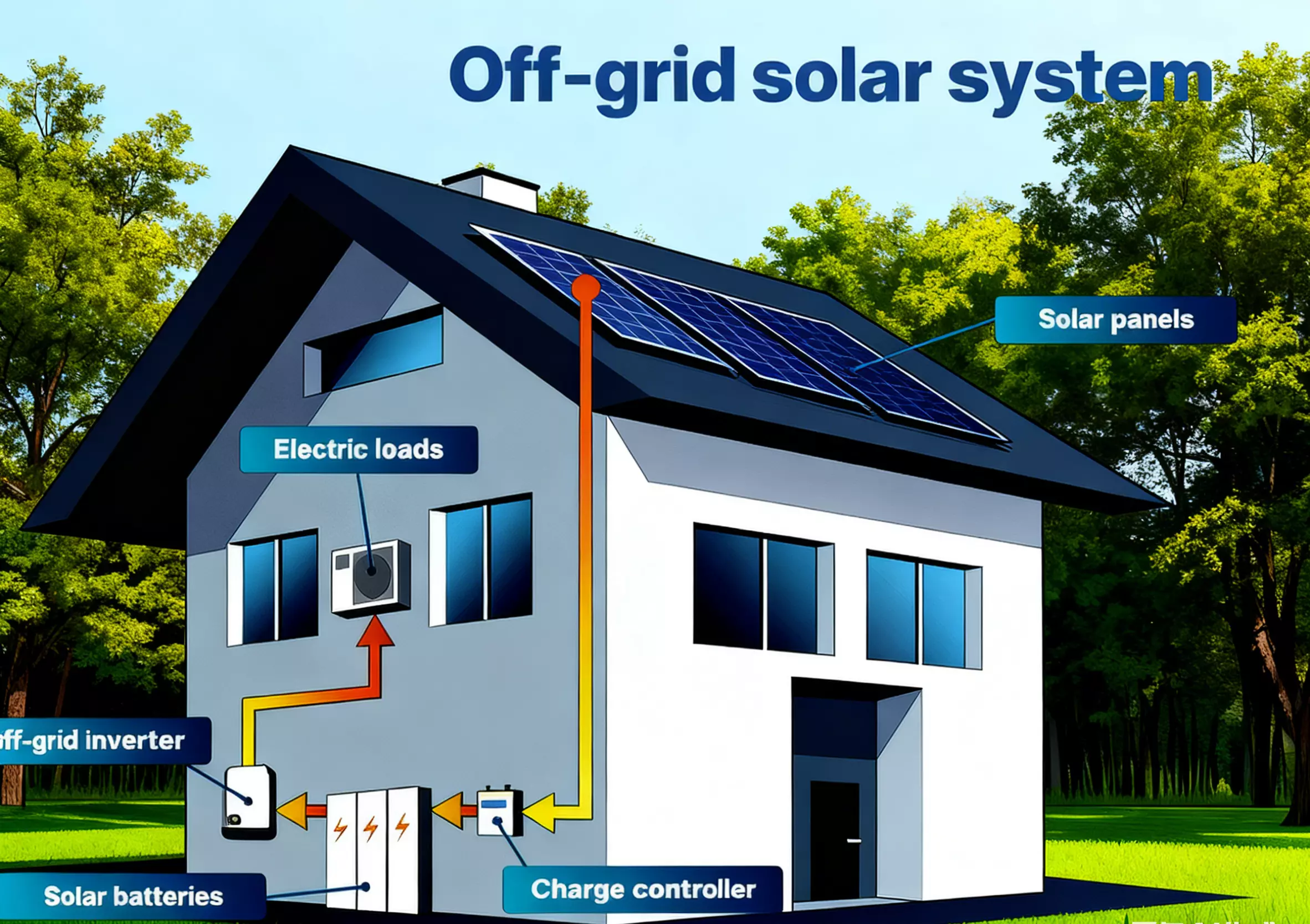
In recent years, whether you live in urban suburbs, rural detached houses, farms, or even off-net huts, you may have clearly felt two things:
Firstly, the electricity price is getting more and more expensive, and secondly, power outages are becoming more and more frequent.
In the past, people chose off-network systems to pursue environmental protection;
Nowadays, people choose off-grid systems to reduce family daily expenses, and also to make homes no longer dependent on the power grid and no longer afraid of sudden power outages in the middle of the night.
Many users told us that they would subconsciously start searching after experiencing a long power outage:
Cheap off grid solar system
Affordable off-grid solar kit
Budget off-grid solar solution
But the reality is:
Cheap off-network systems are often not cheap.
The most common tragedy is like this:
At first, I bought a low-priced inverter or a low-quality battery in order to save money. As a result, after a few months of use, the failure occurred frequently, and finally I had to buy all of them again.
The original budget was only to spend $2,000, but it was repaired and replaced all the way, and finally cost more than $4,000.
This article is to help you avoid stepping on the pit.
We will tell you which parts can be saved and which parts must not be saved; how to build a reliable, durable and long-term economical off-grid solar setup with a limited budget.
If you are going to build a real cost-effective off-grid energy system, the following content will definitely help you spend less money.
What are the key components of the off-grid solar system?
If you want to save your budget and improve performance, the first step is to figure out what parts of an off-network system are composed of, which parts must be purchased, and which ones can be selected.
Next, I will disassemble it for you in the easiest way to understand.
Solar Panels - the core that determines the power generation
The function of solar panels is very direct: they are used to absorb sunlight during the day and convert light energy into electrical energy.
Did you buy a single crystal? Polycrystalline? What's the power? How efficient is it?
These will affect the stability of your whole system.
✔ Tips for saving money:
If the budget is tight, you can consider second-hand solar panels (common in European and American markets)
The number of panels can be expanded later.
Fixed installation is more economical than adjustable brackets.
Inverter - the most unsavable equipment
The inverter is like the brain of the whole system.
It is responsible for turning the direct current in the battery into alternating current that can be used in your home.
Many users are greedy to buy low-priced inverters, and the result is:
Household appliances are overloaded as soon as they are started.
I can't bring the refrigerator and air conditioner.
The inverter repeatedly alarms
It will be broken after a year of use.
This kind of failure is almost always caused by the poor quality of the inverter.
Low-price inverter = one of the biggest traps of the off-grid system.
✔ It is not recommended to save money
✔ Try to choose brand products
✔ Or directly choose a hybrid all-in-one machine (higher security)
Lithium Battery - determines the energy storage life and stability
The battery is one of the most expensive parts of the off-line system, and it is also the easiest place to waste money.
You may be entangled:
Lead acid is cheap, but its lifespan is short.
Lithium batteries are expensive, but they have a long life and high efficiency.
If you want the system to be used for a long time and want to be expanded in the future, lithium batteries are almost a must.
✔ If the budget is tight, you can start with 48V 100Ah
✔ More battery modules can be added in the future
✔ It is recommended not to buy uncertified low-priced batteries → easy to falsely label and short service life
MPPT Controller - the key to power generation efficiency
MPPT is like an "energy manager".
Responsible for maintaining the highest efficiency of charging between solar panels and batteries.
A good MPPT controller can increase power generation by 10%-30%.
✔ It is not recommended to buy PWM (too low efficiency)
✔ MPPT brand priority: Highjoule(HJ Group), LZY Energy, SRNE, etc.
Cable / Circuit Breaker / Security Protection Assembly
Many novices often ignore this part.
But the off-power system is essentially a small power station.
With large current and high voltage, it is easy to cause problems without safety protection.
✔ It is recommended not to save money
✔ Must have: circuit breaker, lightning rearrest, adaptive cable size
( Optional) Backup Generator
For areas with long winters and cloudy days, many families will match a small diesel engine.
The effect is very simple:
Insufficient panel power generation
The battery dropped to 20%.
When the large-load device is started
The generator can help you replenish the power and improve the stability of the system.
✔ It doesn't have to be expensive
✔ Compatible with inverters
Where can I save money? What places should never be saved?
Among users searching forcheap off grid solar system or affordable off-grid solar kit, the most common problem is:
"The budget is limited. Where should I spend the money? Where can I not buy expensive ones?"
In order to avoid you falling into the low-price trap, I directly classify all parts according to many years of industry experience:
✔ The part that can save money (not affecting long-term use)
1. Solar Panel Brackets (Mounting Brackets)
If you install it on the ground, courtyard or roof tile, the bracket can be fully selected:
Simple steel
Aluminum alloy thin material
Second-hand bracket
As long as the structure is stable, there is no need to pursue expensive brands.
Savings range: up to 20–40%.
2. Cable (just plan the length reasonably)
Many users bought cables that were too long at the beginning, but most of them could not be used.
Reasonable planning of the line can reduce unnecessary cable waste.
How to save money?
Draw a wiring diagram first.
Buy it after measuring the distance.
Don't waste too long system wiring.
Save money: save 10-30%.
3. Second-hand solar panels (common overseas)
In Europe, the United States and Australia, many people will sell old panels in the second-hand market after new houses are equipped with new photovoltaics.
These panels:
The performance decline may only be 10%–15%.
The price is half or even lower.
It is very suitable as a budget off-grid solar solution.
Limitation:
You need to test it yourself or find a reliable seller.
4. DIY self-installation
Labor costs are very expensive in many countries.
If you have strong hands-on ability and can understand the wiring diagram, you can save a lot of money by installing it by yourself.
But pay attention to:
⚠ It must be operated in strict accordance with safety standards.
⚠ If you don't know the circuit, you must find a professional.
✘ The part that can't save money (saving is a waste of money)
This is the most critical point in building a low-cost off-grid solar power system.
1. Inverter
Poor quality of the inverter will lead to:
Frequent tripping
High-power equipment is not allowed.
Short life expectancy
Unstable output damages household appliances
Many users save this part of the money, but they are most likely to regret it in the end.
Suggestions:
✔ Choose brand products
✔ Choose at least 3kW or more (ordinary family)
✔ Try to buy an all-in-one machine with MPPT (more worry-free)
2. Battery
Nothing is easier to destroy the system than a poor-quality battery.
Frequently asked questions about low-priced batteries:
Imaginary standard capacity
The number of cycles is extremely low.
Unsatisfied, can't release
Short life (scrapped in 1–2 years)
If you pursue economical off-grid solar setup, you'd rather start with a small capacity than buy inferior batteries.
3. MPPT Solar Charge Controller
Many budget users will think that "just buy a cheap one for the controller", but this is a very dangerous idea.
MPPT controller decides:
Power generation efficiency (10–30% improvement)
Battery life
System stability
The result of saving money is likely to be insufficient power generation and insufficient electricity every day.
4. Safety protection: circuit breaker, lightning protector, battery protection
Safety can never be saved.
The system has high voltage and large current. If there are fewer protective measures:
⚠ Short circuit → Burn inverter
⚠ Lightning → Panel burning
⚠ The battery is overcharged and over-released → directly scrapped
These losses are much more expensive than buying safety accessories.
III. How to choose the appropriate power and energy storage capacity? ( The most easy step to make mistakes)
Choosing the size of the system is one of the most critical steps in building an off-network system.
Many people are not enough to use the system after buying it back because of insufficient estimation.
Next, I will help you judge how much power and battery capacity you should choose in the simplest way.
1. Calculate your daily electricity consumption (Wh / kWh)
You can use this formula:
Daily power consumption = (power per device × usage time) sum
For example, common household equipment:
| Appliance | Power | Daily Usage Time | Daily Energy Consumption (Wh) |
| Refrigerator | 120 W | 24 h | 600 – 800 Wh |
| Laptop | 60 W | 6 h | 360 Wh |
| LED Lights | 10 W × 4 | 5 h | 200 Wh |
| Water Pump | 400 W | 0.5 h | 200 Wh |
| Television | 100 W | 3 h | 300 Wh |
Total approximately 1650–1900Wh (= 1.6–1.9kWh)
- Select inverter power according to requirements
Reference table:
| Inverter Power | Applicable Scenario |
| 3 kW | Off-grid cabin, small standalone house |
| 5 kW | Common choice for average households |
| 8 – 10 kW | High-load homes / light commercial use |
Home users most often choose the 5kW system.
3. Choose the battery capacity
The easiest way is:
Battery capacity (kWh) = daily power consumption × 2 days of standby
If you use 2kWh every day, it is recommended to choose:
2kWh × 2 = 4kWh battery
(Approximately equal to 48V 100Ah × 2 packs)
With a limited budget, it can start from 5kWh and expand the capacity later.
Budget example
1. Ultra-low budget: 800–1500 USD
Suitable for: off-net hut / camping hut
Configuration features:
Second-hand solar panels
Lead-acid battery
Basic inverter
Simple route
Advantages:
✔The lowest cost
Disadvantages:
✘ Short life expectancy
✘ Not suitable for long-term use at home
2. Medium budget: 1500–3500 US dollars
Suitable for: ordinary families basic off-network
Configuration features:
Brand-new solar panels
48V small-capacity lithium battery
Good quality hybrid inverter
MPPT controller
Advantages:
✔ High stability
✔ Suitable for daily use
Disadvantages:
✘ If the air conditioner is running at the same time, the large load may be insufficient.
3. Cost-effective mainstream solution: 3500–6000 USD
Suitable for: long-term family residents who do not want to maintain frequently
Configuration features:
High-efficiency panel
5–10kWh lithium battery system
Brand inverters
Complete line and security protection
Advantages:
✔ Stable performance
✔ Long life
✔ Real cost-effective off-grid energy system
Disadvantages:
✘ High initial investment, but the most cost-saving in the long run
V. Common construction errors & how to avoid them
Many users who search for cheap off grid solar system have experienced the following problems, and we have specially sorted out the most common errors.
1. I bought a cheap inverter.
Result:
I can't bring the refrigerator.
Instant tripping of home appliances
Short life of inverter
Solve:
✔ Don't buy unbranded inverters under any circumstances.
2. Choose the 12V system
12V The current is too large for families, the line cost is higher, and the efficiency is lower.
Suggestions:
✔ Choose the 48V system from the beginning
3. The power of the panel does not match the battery.
The battery capacity is too large and the panel is insufficient → it is not enough to charge during the day.
As a result, there is not enough electricity at night.
Suggestions:
✔ Panel power ≥ 20–30% of the battery capacity
4. Ignore security protection
Without circuit breakers and overcurrent protection, the inverter will burn out.
Solve:
✔ Security components must be fully configured
Recommended cost-effective off-network system configuration
1.3kW Home Basic System
3kW hybrid inverter
48V 100Ah lithium battery
6 × 450W panel
MPPT controller
A full set of security components
2 .5kW cost-effective off-network system (the most popular)
5kW all-in-one machine
48V 200Ah (10kWh) lithium battery
8 × 550W panel
Full set of wiring and protection system
3. 10kW large-load home / commercial system
10kW brand inverter
15–20kWh lithium electricity storage
12 × High-efficiency panel
Complete lightning protection and backup power generation interface
VII. How to "gradually expand the system" with a limited budget?
The best expansion method:
1. Starting from the 48V system
The 48V system is more suitable for future capacity expansion.
2. Buy the basic power of the panel first, and supplement it later.
Solar panels are cheap and easy to expand.
3. Buy 5kWh batteries first, and you can add modules in the future.
Lithium batteries support parallel expansion, which is very flexible.
4. Try to get the inverter in place at once.
It is troublesome to replace the inverter, so it is recommended to buy enough power from the beginning.
VIII. How to build a truly "economical but reliable" off-grid system?
To achieve a truly economical off-grid solar setup, you need to remember a core principle:
It's not that the cheaper the better, but the more reliable it is, the more money it saves.
A long-term stable off-network system must achieve:
Sufficient panels
The inverter brand is reliable
Battery quality pass
MPPT controller is highly efficient
Security components cannot be saved.
The purpose of this article is to help you build a real cost-effective off-grid energy system in the most reasonable and economical way.
If you want to get a more accurate configuration plan according to your home's electricity consumption, please feel free to contact us.