
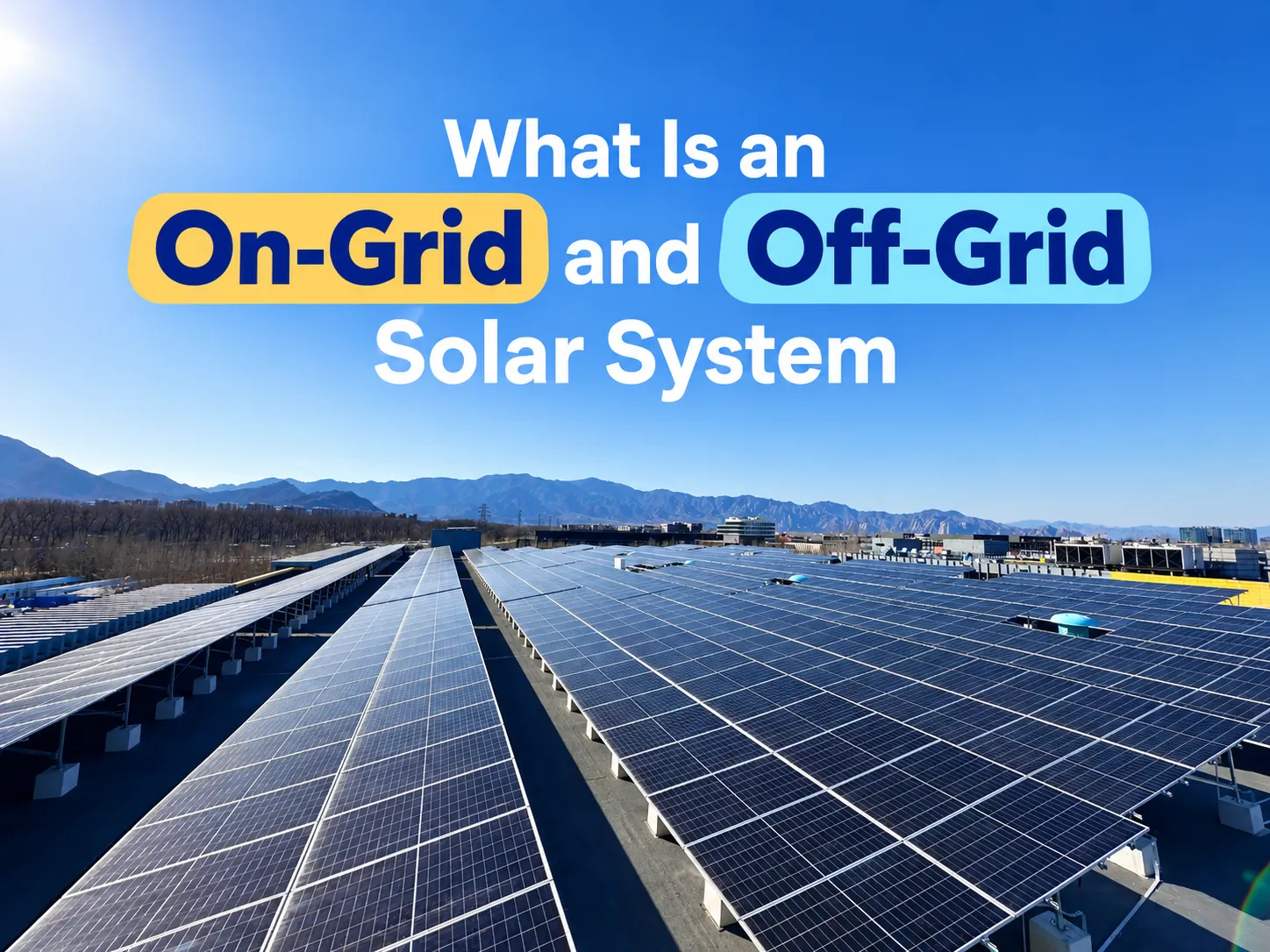
On-grid and off-grid solar systems are two common types of solar installations. The distinction is simple – on-grid is connected to the public electricity grid and able to exchange energy with it. Off-grid works independently relying on battery storage to generate electricity.
In both cases, solar systems use solar panels for converting solar energy into electricity. However, they differ in the equipment used, operating principles, cost, and other factors. This comparison will help both individuals and companies choose a proper solar system.
1. What Is an On-Grid Solar System?
An on-grid system or grid-tied system is connected to the local electricity network. It produces power through solar panels and works together with the utility grid to satisfy energy requirements of the building.
During daylight hours, the solar system produces energy and supplies it to the loads. If there is surplus of produced energy, it can be exported to the grid (based on local utility regulations).
In case of lower solar power generation (during nighttime or cloudiness), the building receives electricity from the utility grid.
Operation of the On-Grid Solar System
- Generation of solar energy: solar panels capture sunlight and convert it into DC (direct current) electricity.
- Conversion of electricity: a grid-tied inverter converts DC power into AC (alternating current).
- Consumption of electricity: produced energy powers household appliances, equipment and other loads.
- Exportation of surplus energy: surplus electricity flows back to the grid when the amount of generated energy is higher than the amount of consumed energy.
- Supply of power from the utility grid: the grid provides power when it is needed.
Key Components of an On-Grid Solar System
- Solar panels: they generate electricity through the absorption of sunlight.
- Grid-tied inverter: it converts DC energy into AC compatible with the grid.
- Electrical distribution panel: it distributes electricity among various loads.
- Utility meter: it measures the amount of electricity exported/imported to/from the grid.
- Protection devices: isolation and safety equipment.
Advantages and Disadvantages
Advantages:
- Reduced initial cost because of the absence of battery storage.
- High efficiency due to less conversions and energy storages.
- Possibility to export surplus energy to the grid.
- Simplest system and maintenance.
Disadvantages:
- Depends on the availability of the utility grid.
- A conventional grid-tied system without backup capability normally shuts down during a grid outage for safety reasons.
- Electricity costs and export compensation depend on local utility policies.
- Provides limited energy independence.
On-grid solar system suits for residential buildings, factories, offices and other commercial facilities with reliable grid connection.
2. What Is an Off-Grid Solar System?
An off-grid solar system or a standalone system operates independently of the public electricity grid. It produces and stores its own power making it appropriate for remote places without reliable grid connection.
Unlike the on-grid system, off-grid system cannot rely on the grid in case of lack of power generation (low sun radiation). Therefore, battery storage is required.
How Does Off-Grid Solar System Work?
The off-grid solar system consists of solar panels, battery system and inverters generating electricity.
Typically, the off-grid solar system's work includes:
- Generation of solar power: solar panels convert sunlight into DC electricity.
- Charging of batteries: a charge controller regulates and redirects DC electricity to the battery storage system.
- Conversion of electricity: an off-grid inverter converts stored DC electricity into AC electricity for powering electrical devices.
- Supplying of electricity: electricity is supplied to loads according to their energy requirements.
- Backup energy supply: at nighttime or during poor sun radiation, the battery supplies stored energy.
Also, large off-grid systems may include diesel generators or wind turbines to compensate for the lack of power generation.
Key Components of an Off-Grid Solar System
- Solar panels: they convert sunlight into electricity.
- Solar charge controller: it controls battery charging and protects from improper charging conditions.
- Battery Energy Storage System (BESS): it stores surplus solar energy for future consumption.
- Off-grid inverter: it converts DC energy into AC electricity.
- Energy management system (EMS): it monitors and manages power generation, battery charging and energy consumption.
- Backup generator: it generates additional power when solar and battery power generation is insufficient.
Advantages and Disadvantages
Advantages:
- Independent from the public electricity grid.
- Appropriate for remote locations without utility infrastructure.
- It can supply electricity during grid outages as it doesn't depend on the grid.
- Gives ability to control own electricity generation and storage.
Disadvantages:
- High initial cost due to required battery storage.
- Planning of solar power generation and battery capacity is required.
- Energy generation depends on solar activity and stored energy.
- Cost of battery maintenance and replacement should be planned in advance.
Off-grid solar systems are often installed in remote villages, agricultural facilities, mining areas, construction sites, telecommunication base stations and other facilities without reliable grid electricity.
3. Comparison of On-Grid and Off-Grid Solar Systems: Main Differences
Both solar systems use photovoltaic panels. However, they have many differences in technical implementation and application.
| Comparison | On-Grid Solar | Off-Grid Solar |
| Grid connection | Connected to utility grid | Independent of utility grid |
| Battery storage | Usually optional | Normally required |
| Initial investment | Generally lower | Generally higher |
| Excess electricity | Can be exported to the grid | Stored in batteries or used by additional loads |
| Nighttime power | Supplied by the grid | Supplied by batteries |
| Grid outage | Conventional systems shut down | Continues operating if sufficient energy is available |
| Energy independence | Partial | High |
| Typical applications | Homes, offices, factories | Remote sites, telecom stations, rural areas |
The important point is not only how many solar panels you install. It is how the system copes with lack of energy generated by solar panels.
In case of on-grid systems, the additional energy comes from the utility grid. In case of off-grid systems, the battery system should be designed to cover these energy lacks.
4. What About Hybrid Solar Systems?
Besides on-grid and off-grid, the hybrid solar system is another type of solar system. It combines solar power generation, battery storage and grid connection.
It can use solar power for powering loads, battery charging and drawing power from the grid. Based on the system configuration, it can also provide backup power when the grid is down through proper inverter and isolation setup.
For example, a commercial facility can use solar power during the day time, charge batteries and use the stored energy during the peaks of electricity cost and nighttime.
The hybrid solar system is especially useful for reducing electricity costs and providing power reliability.
5. How to Choose the Proper Solar System?
There are several practical aspects to consider when choosing on-grid or off-grid solar system.
Choose an on-grid system if:
- your property has reliable electricity connection.
- your goal is saving on electricity bill payments.
- you want a simple solar system.
- battery backup is not important.
Choose an off-grid system if:
- your place has no access to the public electricity grid.
- you operate in remote or isolated areas.
- you need reliable power supply.
- you can afford battery backup.
Commercial and industrial projects should also be analyzed in terms of peak load, daily electricity consumption, seasonal solar resources and future capacity increase.
From our experience, the energy planning for off-grid projects requires special attention. The insufficient battery capacity leads to power failures while excessive capacity increases initial investment unreasonably. Solar energy generation, battery capacity, inverter output and loads requirements should always be estimated together.
Conclusion
On-grid and off-grid solar systems have different purposes. On-grid solar system is typically cheaper for those properties which have reliable utility grid. Off-grid system provides full energy independence for remote locations without public electricity.
For those projects which are aimed at saving costs and reliable power supply, hybrid solar systems can be a good choice as well.
At LZY Energy, we provide solar power and battery energy storage solutions for residential, commercial, industrial and remote applications. Our product range includes solar containers, solar and storage systems and battery energy storage systems tailored to various projects.