
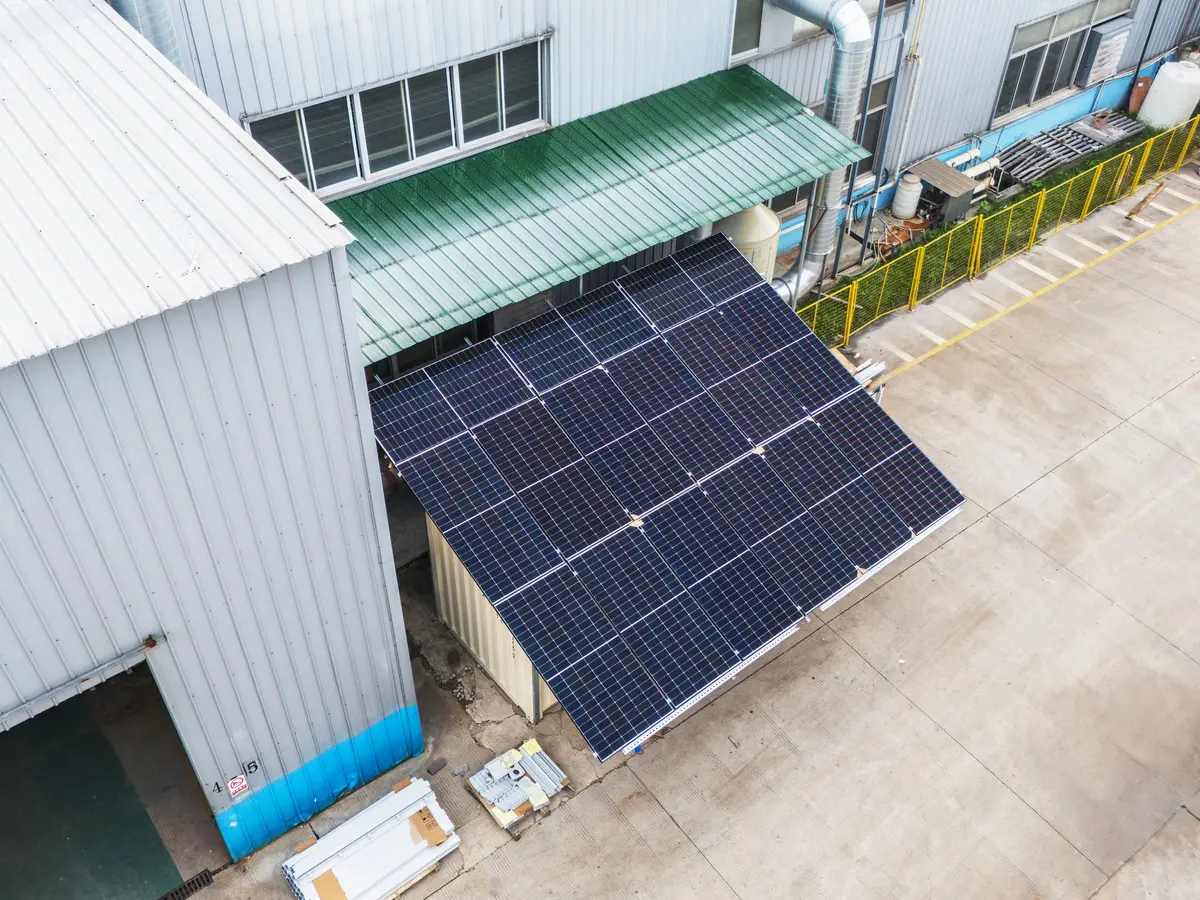
Yes, you can go solar without being tied to the grid! In fact, a stand-alone solar system which includes solar panels and batteries as well as additional equipment can function as an independent source of power for your household or business.
How Does Off-Grid Solar Work?
A standard grid-connected solar PV system can export surplus electricity to the utility grid. This is impossible in case of off-grid solar system and the latter has to have some energy storage capacity as well as some power management equipment.
Typically, an off-grid system consists of the following components:
- Solar panels – generate electricity on sunny days.
- Solar inverter/hybrid inverter – converts solar-generated electricity.
- Energy storage system – stores surplus solar energy for consumption during nights and cloudy days.
- Power management system – controls charging/discharging/energy distribution process.
- Backup diesel generator – in case if you expect your site to consume large amounts of electricity or to experience bad weather conditions for too long.
During the day, solar energy produces electricity which feeds loads connected to the system. When electricity production is higher than consumption, surplus energy can be used for charging the battery. During the night, the battery starts to discharge itself to provide power.
Additionally, a diesel generator can be included in the system. Generator operates only when both solar generation and energy storage are not enough to satisfy the demand of the loads.
Can Solar Panels Work Without Batteries?
Actually, solar panels can generate electricity even without battery but such configuration will not provide any reliable source of power supply.
Solar electricity production varies during the day and it also depends on weather and season conditions. Thus, without battery electricity will be produced by the system only when its production will be enough.
For example, a remote communication site needs to operate constantly. Solar panels can produce energy during the day but the system still needs to cover nighttime consumption. It is why you will need battery storage.
That is why I can recommend you to configure an off-grid solar power system according to the demand of your load and duration of backup rather than the capacity of the PV system.
How Much Solar And Battery Capacity Do You Need?
There is no standard capacity of an off-grid solar system. It always depends on:
- Your electricity consumption during the day.
- Peak electricity demand.
- Solar irradiation in your region.
- Duration of backup days.
- Capacity of batteries.
- Inverter capacity.
- Weather conditions during certain seasons.
For instance, let us say that your remote facility consumes 50 kWh during a day and you need to have two days of autonomy. Thus, your battery system will need to be much larger than 100 kWh nominal capacity because batteries should not be discharged to 100% of their rated capacity.
PV system will also need to generate enough electricity to cover your daily consumption as well as to charge the battery.
It is why off-grid project has to be configured based on real parameters of the site rather than just the ratio of panels to battery.
Where Does Off-Grid Solar Make Sense?
Off-grid solar system is very effective for regions where extension of the utility grid is too expensive or technologically difficult or even impossible.
Some examples are:
- remote homes and cabins;
- telecom base stations;
- rural communication sites;
- farms and agriculture facilities;
- construction sites;
- mining and industrial sites;
- road-side monitoring stations;
- emergency communication systems;
- temporary power projects;
- commercial facilities located in remote areas;
For instance, a telecom site can use a hybrid solar power system which includes solar, battery storage, diesel generator and other renewable energy sources and thus can provide more reliable power supply than just solar panels.
Off-Grid Solar Vs. Grid-Connected Solar
Both systems are totally different and have different purposes.
| Feature | Off-Grid Solar | Grid-Connected Solar |
|---|---|---|
| Utility grid required | No | Yes |
| Battery storage | Usually essential | Optional |
| Can operate during grid outage | Yes | Depends on system design |
| Excess solar | Stored or curtailed | Can be exported |
| Suitable for remote areas | Excellent | Limited |
| System design | More complex | Generally simpler |
| Backup generator | Sometimes useful | Usually unnecessary |
One important thing to note is that a standard grid-tied solar PV system cannot be simply disconnected from the grid and expected to keep working. Most grid-tied inverters turn themselves off during grid outage because of electrical safety reasons.
If you need independent operation, the system has to include equipment which will support it.
Is Off-Grid Solar Reliable?
Yes, if it is configured properly.
The hardest part is not to generate electricity on sunny days but to have stable power supply during poor generation.
Thus, a reliable system needs to have enough battery capacity, proper PV generation, right inverter capacity as well as proper backup system.
If the project is implemented in regions with frequent cloudy weather or high electricity consumption, a hybrid solar+battery system with diesel generator backup can be more beneficial than pure solar+battery configuration.
At LZY Energy, we consider such a solution especially effective for remote and commercial projects because the aim is not just to add some solar panels but to create a reliable energy system which will work in real-life conditions.
Conclusion
Can you have solar without being connected to the grid? Yes, you can. Off-grid solar system will provide you with an independent power supply but it has to be configured as a whole power system and not just solar panels.
For residential project, you will probably need solar panels, batteries and inverter. However, for remote and commercial projects, you can use solar panels together with Battery Energy Storage Systems, diesel generator, wind power and energy management system.
The best configuration will depend on electricity demand, solar resource and your operational conditions.