
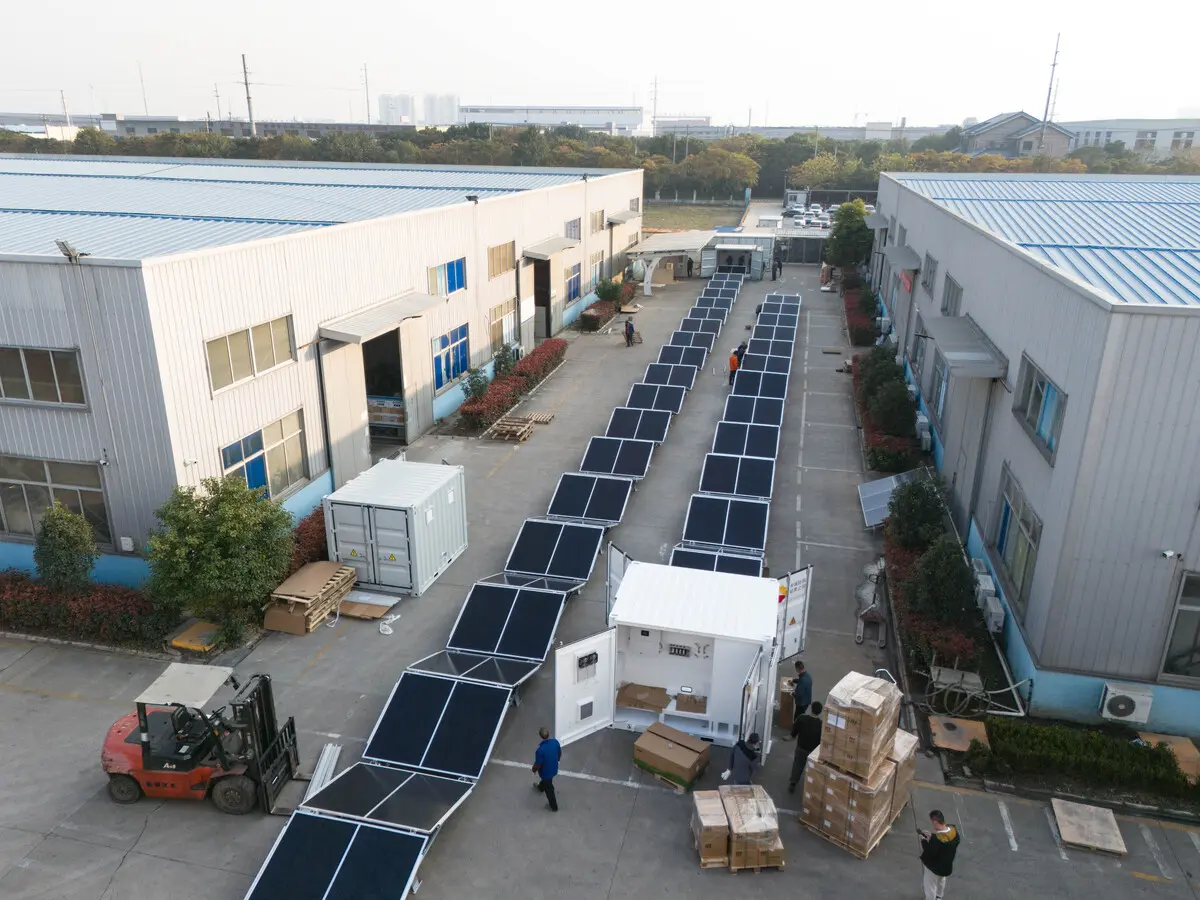
Solar power plant for factory can provide manufacturers with the ability to decrease the use of electricity from the grid, save on costs, and enjoy flexible power supply. For those who don't have enough space on the roof or require temporary factory space, a mobile folding solar container may be an excellent substitute for a stationary PV installation.
Why Factories Need Solar Power?
Electricity is one of the largest expenditures for factories. Production lines, motors, compressors, pumps, cooling systems, HVAC units, and lighting consume electricity all day long.
According to recent statistics in the United States, energy management still plays a crucial role in industrial facilities. The industrial sector consumed 33% of the total U.S. energy consumption in 2025. Additionally, the cost of electricity per kilowatt-hour increased by 5.1% year over year in May 2026 for U.S. industrial customers.
Producing power independently on the spot can help to reduce the dependence of the facility on the grid supply. Photovoltaic power plants are especially helpful for facilities having high loads during the day since the generated power will be used directly.
In plain English, solar panels produce electricity, then the inverter converts it into usable alternating current, and the factory consumes the produced power. If the solar generation is not enough, then the grid will supply the necessary electricity.
How Does a Factory Solar Power System Work?
Factory solar system may consist of such major components as:
- Solar PV modules
- Combining PV equipment
- Solar inverter or PCS
- Battery energy storage system
- Energy management system
- Equipment for the connection to the grid
- Equipment for monitoring and protection
During the daytime, PV modules generate electricity. Then the inverter converts DC electricity into the appropriate AC electricity.
The factory consumes the solar electricity directly for its production purposes. Excess of generated power can be saved in the batteries in case if battery storage is used.
With the decreasing of solar generation, stored power can be used. The grid is always available for additional electricity supply.
Such configuration allows providing the factory with more flexibility as compared to the dependency on the solar power or the grid supply.
What Are the Benefits for a Factory?
Decrease Grid Electricity Consumption
The most direct benefit is the reduction of the purchased electricity quantity.
If the factory has high loads during the day, it can consume quite a lot of produced solar power. This is usually more attractive than the production of electricity when there is a small factory demand.
The exact financial benefit will depend on electricity prices, solar potential, system capacity, local regulations, and the load profile of the factory.
Manage Energy Costs
Electricity prices may differ according to the region, time of the year, and the moment of the day. The usage of battery storage will allow shifting part of the energy consumption.
For example, excess electricity from solar generation during the daytime may be saved and then consumed later when solar production is low. It may be also beneficial in case if there is the time-of-use electricity pricing.
Helps with Factory Expansion
During the factory expansion, new production lines may appear or a factory may temporarily expand into a workshop. Such process leads to an increase of electricity demand before the full development of permanent infrastructure.
Modular solar and storage system will help to provide additional power without waiting for the realization of a full-scale PV project.
Increase Power Flexibility
Using solar generation with battery storage will allow consuming selected loads of the factory during grid interruptions.
However, it doesn't mean that the solar and batteries must replace an industrial UPS system automatically. Critical loads may require certain types of switching devices like ATS, STS, UPS or others depending on the response time and operating conditions.
Why Add Battery Storage?
Solar generation is often out of phase with the factory electricity demand.
The factory may operate from early morning till late evening while the solar generation is available only during the day. The factory demand may also differ during the day.
Here the role of battery storage comes.
Usually, the process looks as follows:
- Solar electricity supplies factory loads during the day.
- Excess solar electricity charges the battery.
- The battery stores energy for future consumption.
- The stored energy helps with the consumption of factory loads with decreasing of solar production.
- Additional electricity is provided from the grid when required.
This strategy is especially useful for the multi-shift operation.
The capacity of the battery must be selected according to the real load profile and not just the selection of the largest available battery. First of all, it is necessary to analyze the electricity consumption, peak demand, operating hours, and tariff structure.
Why Use a Mobile Folding Solar Container?
Most solar power plants for factories are permanently mounted on the rooftops or fixed structures on the ground. In case of a factory with a stable location and enough installation space, this may be an effective solution.
But not all industrial projects have the same demands.
Sometimes, factories create temporary production areas, expand facilities, have remote processing centers, or move equipment between projects. For these projects, a stationary solar installation may not be appropriate due to the change of the site or the power requirement.
Mobile folding solar container solves this problem thanks to its transportable design.
Solar panels are integrated in the containerized structure. During transportation, PV array is protected inside the system being folded. Then, once the container arrives to the required location, PV array can be deployed to produce electricity.
It means that the solar generation equipment does not have to remain permanently connected to one location.
Applications of a Mobile Folding Solar Container for a Factory
A mobile folding solar container may be useful for several industrial applications.
Temporary Production Areas
Factories may require the additional production capacity for seasonal orders or temporary projects. The mobile solar system can help to provide this capacity without building a stationary PV system.
Factory Construction and Expansion
During the factory expansion, construction equipment, temporary buildings, lighting, monitoring systems, and other facilities may require the additional power. A mobile solar and storage system can supply such loads.
Remote Industrial Facilities
Sometimes, factories and processing facilities operate far away from the reliable grid infrastructure. Solar generation may be combined with battery storage and diesel generators to build the hybrid power system.
It will help to reduce the running time and fuel consumption of generators with the help of solar energy.
Factories With Limited Roof Area
The factory may have the big electricity demand but limited space for PV installation due to the structural constraints, HVAC equipment, skylights, or any other installations.
In case of the availability of the outdoor space, mobile container can become an alternative place for deploying PV modules.
Emergency Power
Together with the appropriate battery capacity and electrical switching equipment, the system can provide the backup electricity for selected loads of the factory during the grid interruption.
How Big Must Be a Factory Solar System?
There is no optimal system size for all factories.
The system must be designed according to the real electricity consumption and operating conditions. The main factors to consider are as follows:
- Daily electricity consumption
- Peak electrical demand
- Operating hours of the factory
- Distribution of loads during the daytime and nighttime
- Solar irradiation in the location
- Available installation area
- Electricity tariff structure
- Capacity of the grid connection
- Duration of the backup
- Battery capacity
For factories operating mainly during the day, the direct consumption of solar energy may become the priority.
For the factories with two or three shifts, the role of battery storage becomes more prominent since a part of the electricity consumption falls outside the period of solar production.
From the engineering point of view, load analysis must precede the equipment selection. Installation of the maximal possible capacity of the PV modules is not necessarily the best choice. The aim is to make the optimal balance between solar generation, battery storage, factory demand, and grid electricity.
LZY Energy Mobile Solar Solution
LZY Energy mobile folding photovoltaic container can be used for factory applications where the deployment flexibility is required.
Depending on the project requirements, the system may include solar PV modules, battery storage, PCS, energy management equipment, and other electrical equipment.
The system can be used in the following applications:
- Temporary factory power
- Factory expansion projects
- Remote industrial facilities
- Mobile manufacturing operations
- Hybrid solar and battery systems
- Backup power
Additionally, the containerized design provides an important advantage for projects which may change over time. After the completion of the first project, the equipment can be transferred and used at the other site.
Conclusion
Solar power system for factory must be designed according to the real electricity demand of the factory but not the installation area available.
In case of strong loads during the day, solar PV can directly offset the grid electricity consumption. Battery storage adds flexibility by allowing using the excess of solar electricity during the night.
The July 2026 outlook on electricity published by IEA expects the global electricity demand growth by 3.6% in 2026 and 3.8% in 2027, showing further growth of electricity use in the global economy.
For factories with the stable locations and appropriate rooftops, stationary PV system may remain the most straightforward choice. However, in case of the requirements for the mobility, temporary deployment, fast deployment, or equipment reuse, the mobile folding solar container may be much more flexible.
For these purposes, combining the solar generation with battery storage and energy management allows making the transportable container a flexible power solution for modern industrial facilities.